© 2026 Casey Spitnale
Conclusion
Seeing God in the Sting
“Some have said that honeybees are messengers sent by the gods to show us how we ought to live: in sweetness and in beauty and in peacefulness.”
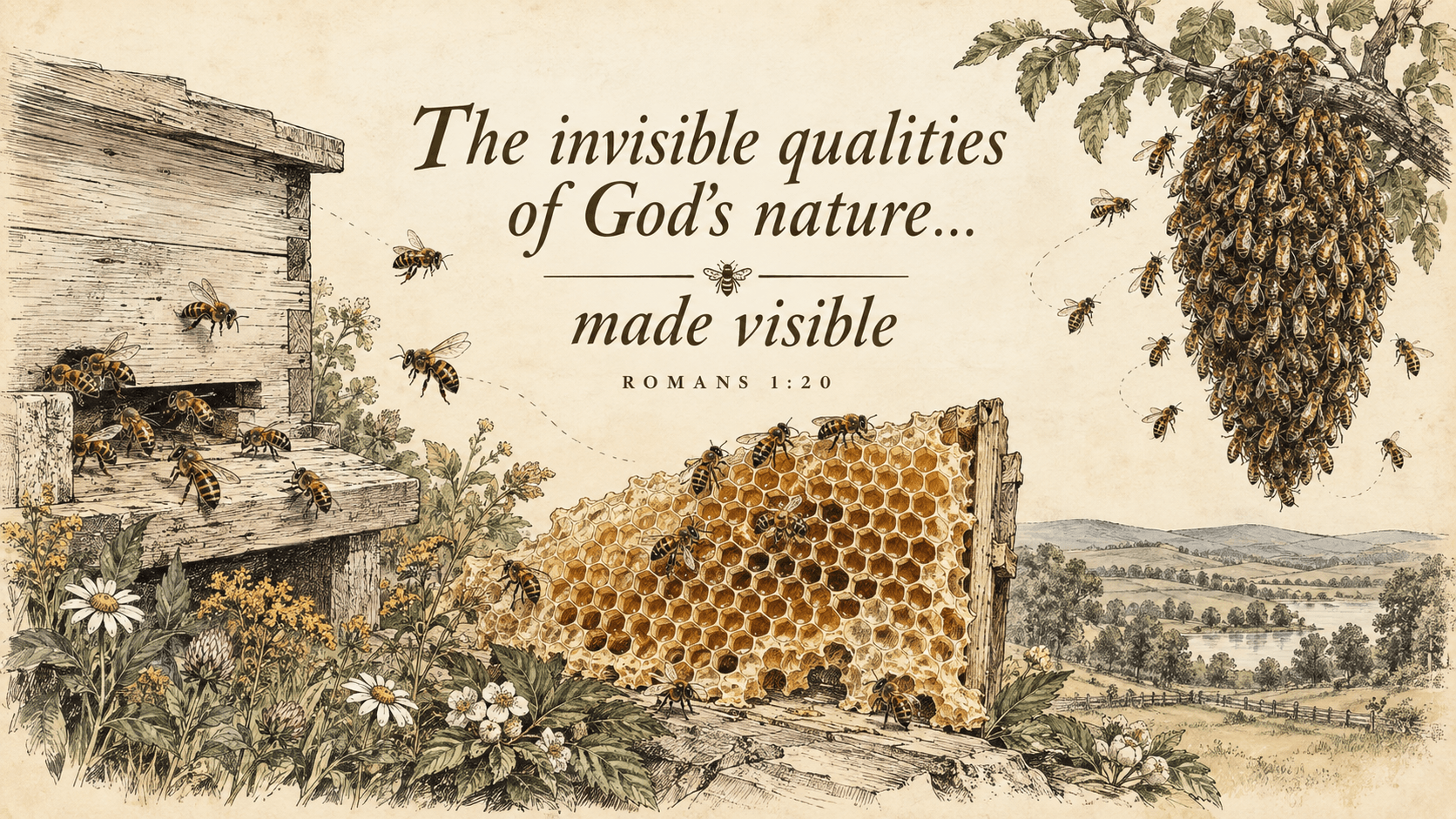
The conclusion pulls together the book's three recurring threads, order, sacrifice, and beauty, and argues they're not incidental to a hive, they're the whole design. Casey ties that argument to the sting itself: a bee's stinger tears free and keeps pumping venom for up to twenty seconds after she's gone, and the alarm pheromone released in that same instant rallies the rest of the hive to defend it. Her death isn't a design flaw. It's built into the purpose. The 1st Minnesota's charge at Gettysburg carries the same weight in human terms. Two hundred sixty-two men charged a brigade roughly six times their size to buy the Union line five minutes to reform, and two hundred fifteen of them fell, the highest casualty rate any surviving American unit has taken in a single engagement. Hancock called it gallant. Corporal Philip Hamlin, who survived that charge only to die the next day at Pickett's Charge, had already written home that he trusted himself to be in safe hands regardless of what came. Casey reads both stories against Psalm 23:6 and the book's anchor verse, Romans 1:20: goodness and sacrifice aren't separate from the design, they follow directly from it, in a bee colony and in a regiment alike. The book closes by turning that same argument toward Casey's own life, naming the family who lived alongside every hive inspection and every chapter, and asking the reader to go find a hive of their own worth watching that closely.
Bee Science
- Sting autotomy is a documented defensive mechanism
- the barbed stinger and venom sac tear free and keep pumping after the bee is gone, her death built directly into the colony's defense
- Venom delivery speed after the sting tears free
- at least 90 percent of a bee's venom empties from the detached sac within twenty seconds of the sting tearing free, while the alarm pheromone it releases rallies the rest of the hive
Cited research (2)
- H.R. Hermann (1971), "Sting autotomy, a defensive mechanism in certain social Hymenoptera," Insectes Sociaux 18: 111-120: Studies the autotomy mechanism itself (the barbed stinger tearing free); confirmed correctly dated 1971 after an earlier project note had mistakenly logged it as 1972
- Schumacher, M.J., Tveten, M.S. & Egen, N.B. (1994), Journal of Allergy and Clinical Immunology 93: 831-835: Measured venom-delivery timing after the sting tears free (at least 90% within 20 seconds, complete within a minute); corrects an earlier project draft that had misattributed this timing detail to Hermann's 1971 study
Scripture
Anchor: Romans 1:20
Also touches
Civil War Recordcivil war
The 1st Minnesota's charge at Gettysburg, July 2, 1863
- On July 2, 1863, the second day at Gettysburg, after the Union line broke where Sickles' corps had been posted, General Hancock ordered the 262 men of the 1st Minnesota to charge a fresh Alabama brigade roughly six times their size, buying the rest of the line five minutes to reform
- 215 of the 262 men fell (killed, wounded, or missing) — 82 percent, the highest casualty rate any surviving American military unit has taken in a single engagement, before or since; Hancock said of the charge, "no more gallant deed recorded in history" (confirmed 2026-09-09 as a real, widely documented quote)
- Cpl. Philip Hamlin survived the charge only to die the next day in the repulse of Pickett's Charge. His last letter home, dated June 25, 1863, closes: "I know that whatever befalls me, all is well for I am in safe hands. Oh, it is sweet to trust in the All Seeing One..." — sourced to killedatgettysburg.org's dedicated Hamlin biography, which draws on his actual wartime letters; his comrade Sergeant James Wright's tribute ("an honest, earnest, consistent, Christian man") is correctly named and quoted, correcting an earlier draft's vague, unattributed paraphrase
- The book's closing attrition comparison cites the Civil War Centennial Commission's 1960 Facts about the Civil War: the Light Brigade at Balaklava lost 37 percent of its men, and in the Civil War, 63 Union regiments lost more than half their strength in a single engagement (at least 120 lost more than 36 percent) — the 1st Minnesota's 82 percent stands above all of them
- A follow-up research pass cross-checked the casualty figures against an independent source (a documentary fundraising proposal citing ~220 rather than 215 losses) and judged the discrepancy likely imprecision in a rough, uncited document, not a correction; the manuscript's already-confirmed 215-casualty, 82-percent figure stands
Primary sources (4)
- killedatgettysburg.org, Philip Hamlin biography
- Civil War Centennial Commission, Facts about the Civil War (1960)
- notes/research/first-minnesota-sources-slot-hunt.md
- research/bee-facts-and-meade-council-2026-09-13.md
verified
From the Book
Bees teach you more than you'd expect. Order, sacrifice, beauty, all humming away in a stack of wooden boxes. One evening I stood by my hive with the smoker gone cold, just watching. The last foragers came in heavy with pollen, wings frayed from all the miles they'd flown. Guards held the entrance. House bees capped cells. Every bee moved like it knew exactly where it belonged, and the whole thing felt less like an inspection and more like a hymn. After all these seasons of stings and honey, I finally get something I didn't as a kid pedaling past those same white boxes with my eyes shut: the hive is a mirror. God's design wakes us up, His sacrifice builds us up, and His beauty runs through all of it. Once you've seen it, you can't unsee it. The hive's order is its heartbeat. Fifty thousand bees split into roles, house bees scrubbing cells, foragers dancing out directions to the nectar, and chaos never gets a foothold. They clean, feed, build, guard, and fetch, and all those jobs together add up to a colony that runs like nothing else in nature, honey capped, pollen packed, propolis set in place. Sacrifice fuels all of it. Guards sting and die for it. Foragers fly until their wings shred for it. Every loss becomes a gain for the whole colony. And the beauty is what all that buys you: comb dripping gold, pollen glowing in the cells, a hive so alive you can practically taste it. I've held that comb in my own hands, scooped that honey myself, and none of it reads like an accident to me. It reads like God, showing up in every buzz.
Get the full book →