© 2026 Casey Spitnale
Chapter 22
A Clock Nobody Wound
“The time memory of certain social insects (bees, ants, termites) is on a higher level. These animals, after 'training,' are capable of determining any hour of the day, and their time memory is independent of external periodicities.”
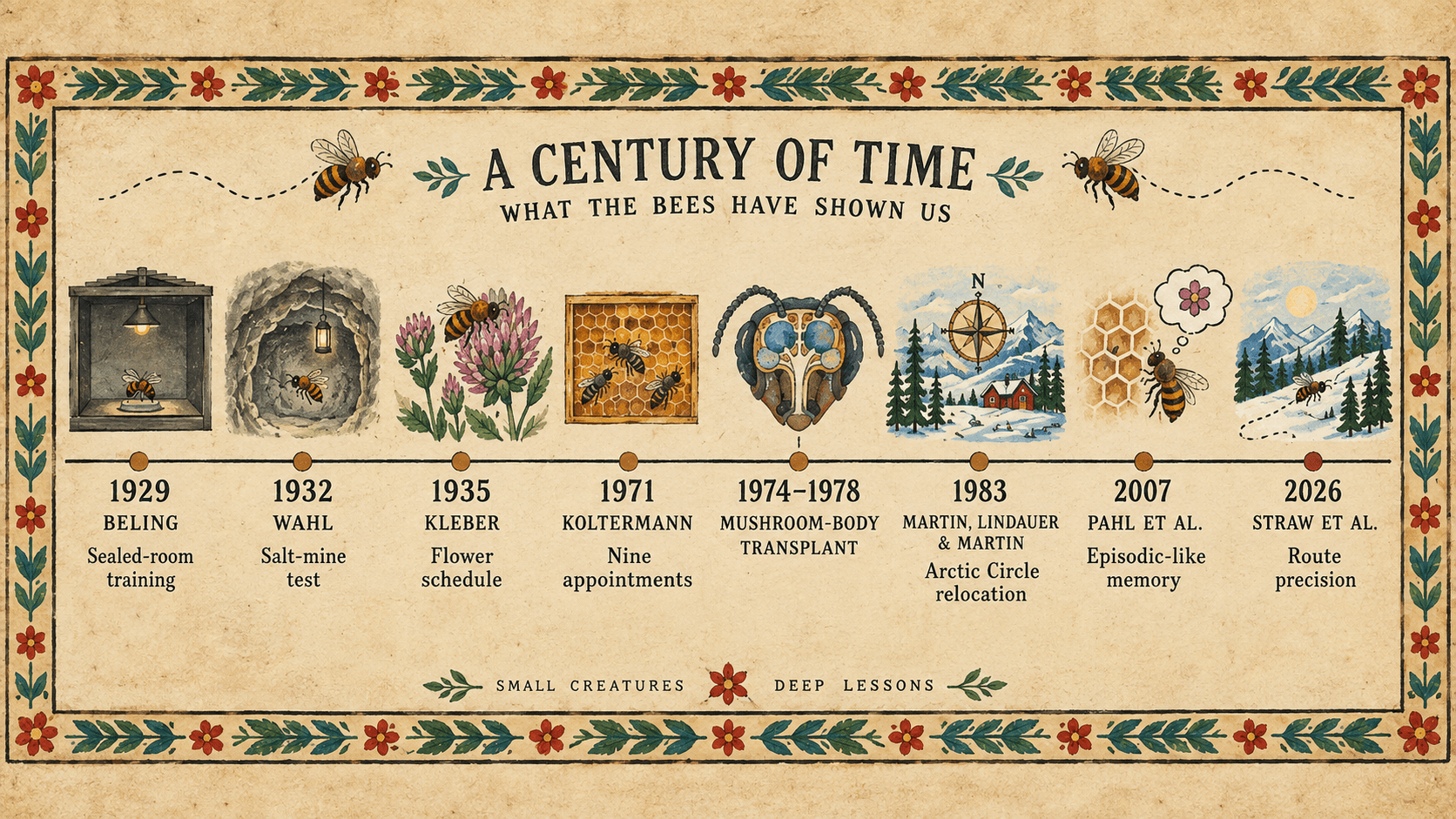
This chapter picks up where chapter 11 left off: Beling proved in 1929 that a bee keeps a working internal clock even shut away from daylight. Casey uses this chapter to trace what nearly a century of researchers did with that discovery, and to draw a contrast between the bee's timing and the best human engineering of its own era. At Petersburg in 1864, Lieutenant Colonel Pleasants' mine went off more than an hour late because a fuse died at a splice, and two men had to crawl back into a tunnel packed with gunpowder to relight it by hand. Wahl's bees, tested the same century in a salt mine shielded from nearly all cosmic radiation, kept perfect time without anyone checking on them at all. Nobody had to climb back down and fix anything. That contrast is the chapter's real argument. Every attempt to explain the bee's clock as something ordinary, background radiation, a general habit, an outside signal picked up like a radio broadcast, failed under testing. What was left standing each time was more exact than an accident has any business being: nine tracked feeding times, a learned schedule that transplants along with the brain tissue that holds it, memory precise enough to bind what, where, and when into one recollection. Casey reads that pattern through Romans 1:20 and Ecclesiastes 3:1 together: a built-in sense of timing, in a creature too small to know it's demonstrating anything, is exactly the kind of invisible quality Paul says gets made visible in what's been built.
Bee Science
- Wahl's 1932 salt-mine control
- bees tested for time-memory deep in a salt mine, shielded from nearly all cosmic radiation, kept perfect time anyway, ruling out radiation as the cue they were reading (exact depth/location of the mine unverified — see notes below)
- A bee can juggle up to nine feeding times a day
- Rudolf Koltermann pushed Wahl's five-or-six-appointment finding to nine separate daily feeding times, each only forty-five minutes apart and tagged with its own scent or color cue
- Mushroom-body transplant transfers a learned feeding time
- surgically swapping the mushroom bodies (the brain's memory center) from an evening-trained donor bee into a midday-trained host bee shifted the host onto the donor's schedule within three to five days, replicated in more than twenty-five separate experiments
- Episodic-like memory: what, where, and when together
- bees trained to expect one flower pattern at one location each morning and a different pattern/location each afternoon scored 83 percent correct overall, and 91 percent in one stripped-down color-only test, evidence of bound "what-where-when" memory, a term borrowed from scrub-jay caching research
Cited research (8)
- Beling (1929), Zeitschrift für vergleichende Physiologie 9(2): 259-338: The founding 1929 doctoral thesis proving a honeybee keeps a working, roughly 24-hour internal clock even sealed away from every external time cue; already told in ch.11 and recapped as this chapter's springboard
- Wahl (1932), Zeitschrift für vergleichende Physiologie 16: 529-589: Ran the salt-mine cosmic-radiation control and the untrained-bee control confirming Beling's result was a specific trained memory, not general bee behavior
- Kleber (1935), Zeitschrift für vergleichende Physiologie 22: 221-262: Traced the bee's time memory to the flowers' own daily nectar/pollen release schedule, ruling out plain hunger as the driver
- Koltermann (1971), Zeitschrift für vergleichende Physiologie 75: 49-68: Found a bee can hold nine separate feeding appointments in a single day, 45 minutes apart, each tagged by scent or color
- Martin, Martin & Lindauer (1978), Journal of Comparative Physiology 124: 193-201: Mushroom-body transplant experiments: a learned feeding time transfers from donor to host bee within 3-5 days, replicated 25+ times
- Martin, Lindauer & Martin (1983), Sitzungsberichte der Bayerischen Akademie der Wissenschaften: Argued, via Swedish Lapland relocation trials and Helmholtz-coil field-scrambling, that the bee's time sense reads Earth's magnetic field rather than running on a purely internal clock; the two most thorough modern reviews (2024, 2025) don't engage the claim at all — see notes/research/martin-lindauer-martin-1983-saltmine-emf.md
- Pahl et al. (2007): Established honeybee 'episodic-like memory,' what, where, and when bound together in one recollection, a term borrowed from scrub-jay caching research
- Straw et al. (2026), Current Biology: Tracked 255 individual foraging flights; each bee retraced her own route to within centimeters, tighter near landmarks than over open ground
Scripture
Anchor: Romans 1:20
Also touches
Civil War Recordcivil war
The Petersburg Mine / Battle of the Crater, July 30, 1864
- Lt. Col. Henry Pleasants had the men of his own 48th Pennsylvania, most of them anthracite miners from Schuylkill County, dig a 510-foot tunnel under the Confederate line at Petersburg, packed at the far end with four tons of gunpowder
- Pleasants lit the fuse at 3:15 a.m. on July 30, 1864, set to blow at 3:30; more than an hour past that time, nothing had happened
- Sergeant Henry "Snapper" Reese and Lieutenant Jacob Douty crawled back into the tunnel not knowing whether the powder would explode under their own boots, found the fuse had died at a splice, spliced and relit it themselves; the mine finally exploded at 4:44 a.m., killing close to three hundred Confederate soldiers instantly
- Grant called the botched follow-up assault, which bogged down inside the crater itself, "the saddest affair I have witnessed in this war"; nearly thirty-eight hundred Union men were lost
- Facts were cross-checked against two independent sources (Encyclopedia Virginia for the exact fuse timing and both volunteers' names; American Battlefield Trust for tunnel length, powder amount, and Grant's quote); minor source discrepancies on tunnel length (510 vs. 586 ft) and crater width (60-100 ft) were resolved by using the American Battlefield Trust figures already established as this project's citation family, with crater width left out of the manuscript entirely rather than picking an unverified number
Primary sources (2)
- Encyclopedia Virginia
- American Battlefield Trust
verified
From the Book
Chapter 11 already told you what Ingeborg Beling proved in 1929: a honeybee carries a working clock inside her, accurate to about a day, and she keeps it running even sealed in a room with the sun shut out entirely. What that chapter didn't have room for is how much further the rest of the century pushed on that one discovery, and how strange the ground under it eventually got. This chapter is that story, told fast. "There is a time for everything, and a season for every activity under the heavens." (Ecclesiastes 3:1) Beling's own lab wasn't finished the moment she defended her thesis. A colleague named Oskar Wahl spent 1932 closing every door skeptics could still point to. First he ran the control Beling herself hadn't: untrained bees, watched the same way, showed no preference for any time of day at all. Whatever Beling had found wasn't some general bee habit. It was a memory, specific to the hour she'd actually trained them to. Then Wahl went looking for the one cue nobody could rule out from an ordinary lab. Cosmic radiation reaches the Earth's surface constantly, and some researchers in 1932 genuinely wondered whether some trace of it, invisible and untestable in a normal room, might be quietly setting a bee's schedule. Wahl took the question underground, into an actual working salt mine, where that radiation is filtered down to almost nothing by the rock overhead. The bees kept perfect time anyway. Whatever they were reading, it wasn't coming down from the sky.
Get the full book →