© 2026 Casey Spitnale
Chapter 21
The Queen's Chemical Crown
Speaking Without Words
“As there is a peculiar smell in each hive of bees, which appears to be the bond of union in the community of it,—bees knowing each other by smell—the intelligent bee-master will keep his hives as far asunder as he conveniently can.”
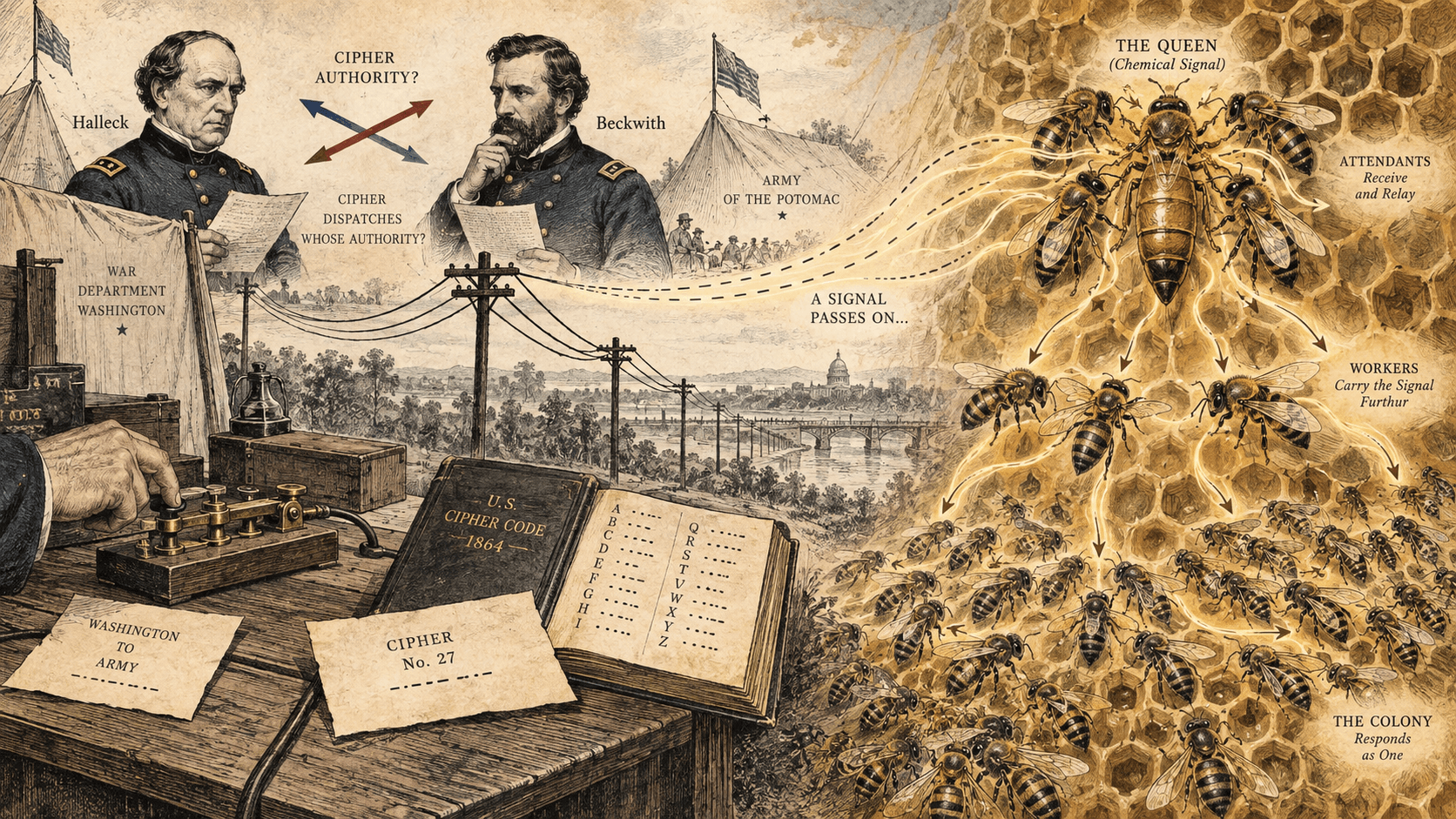
The chapter opens with the cost of getting authority wrong: Casey introduces a new queen to a hive only twelve hours into being queenless, and the workers ball her cage within seconds. They aren't confused about what she is. They just haven't recognized her yet, because her chemical signal, mostly the compounds that make up Queen Mandibular Pheromone, hasn't had time to spread through the colony and replace the scent of the queen they lost. That same question, who's actually authorized to hold the code, plays out in the Grant/Beckwith/Halleck cipher dispute the chapter tells alongside it. Beckwith wasn't wrong that the cipher mattered. He was caught in a real dispute over who had standing to know it, and it took Grant's own intervention to settle who counted as legitimate. Casey's point isn't that chemistry and command work identically. It's that recognition takes time in both systems. A queen doesn't announce her authority once and get obeyed; her scent has to saturate the hive before fifty thousand workers stop treating her as a stranger. Paul's language in 2 Corinthians 2:14-15, the aroma of Christ spreading through those who encounter it, works the same way in the chapter's reading: presence recognized, not command issued, is what actually holds a body together. The chapter's closing argument, that scrambled communication (not any single villain) shows up across the science of Colony Collapse Disorder, extends that logic one step further: cut the signal off entirely, in a hive or a church, and the parts don't stop moving. They just stop moving with purpose.
Bee Science
- QMP's 9-ODA does triple duty
- the queen mandibular pheromone component 9-ODA suppresses worker ovary development, draws in her retinue, and (at long range) works as her sex pheromone drawing drones in from the Drone Congregation Area; a dedicated drone-antenna receptor, AmOr11, responds to 9-ODA and nothing else tested
- Subspecies temperament is genetic, not just chemical
- the gentle Italian honey bee and the more defensive Africanized honey bee are the same species, Apis mellifera; how fast a colony comes boiling out of a box is mostly written in their genes
- Serotonin receptors concentrate in the royal-jelly gland
- the nurse's hypopharyngeal gland, which produces royal jelly, carries the bee's heaviest concentration of serotonin receptors; the team that mapped them in 2013 floated a 'tempting speculation,' offered explicitly as a guess, that serotonin signaling there may help decide which larvae become queens
- Colony Collapse Disorder has no single settled cause
- the widest CCD study to date, thirteen scientists measuring sixty-one variables across ninety-one apiaries, found 'no single factor was found with enough consistency to suggest one causal agent,' only that collapsing colonies carried more pathogens, and more kinds of them, than healthy ones
Cited research (5)
- Wanner et al. (2007), PNAS 104: 14383-14388: Identifies 9-ODA as the QMP component doing triple duty (retinue, ovary suppression, drone attraction) via the dedicated AmOr11 receptor; the same validated dataset used for ch.1's pheromone chart, cited here for this chapter's own 'Chemical Orchestra' table
- Breed, M.D., Guzmán-Novoa, E. & Hunt, G.J. (2004), Annual Review of Entomology 49: 271-298: Defensive-behavior genetics across Apis mellifera subspecies; source for the chapter's Italian-vs-Africanized comparison (same paper ch.7 cites for a different finding)
- Thamm et al. (2013), PLOS ONE 8: e82407: Maps serotonin receptor concentration in the nurse's hypopharyngeal (royal jelly) gland; offers a hedged 'tempting speculation' that serotonin signaling may help determine queen caste
- Henry et al. (2012), Science: Sublethal neonicotinoid doses impair a forager's ability to find her way home; cited in the chapter's CCD/pesticide paragraph
- vanEngelsdorp et al. (2009): Widest CCD study to date (13 scientists, 61 variables, 91 apiaries): 'no single factor was found with enough consistency to suggest one causal agent'; cited in the chapter via Marra (2014)
Scripture
Anchor: Romans 1:20
Also touches
Civil War Recordcivil war
The January-February 1864 Grant/Beckwith/Halleck cipher-key dispute
- In January 1864, before leaving to inspect operations in Tennessee, Grant ordered his own cipher operator, Captain Samuel H. Beckwith, to hand the War Department's cipher key over to one of his staff officers so headquarters could keep decoding dispatches while he was away
- Beckwith refused at first, citing his standing orders straight from the War Department; Grant pushed back, "I told him if he did not he most certainly would be punished," and Beckwith handed over the key
- When Washington found out, General Henry Halleck was furious, declaring that Beckwith "should have gone to prison" over it, and dismissed him on the spot
- Grant took the blame himself on February 4, 1864; Beckwith was reinstated February 14 and stayed at Grant's side decoding his dispatches for the rest of the war (he was later the first man in the country to telegraph word of John Wilkes Booth's whereabouts after Lincoln's assassination)
- Beckwith's rank, given in the manuscript as Captain, was independently cross-checked against Wikipedia, Find a Grave ("Capt Samuel Horace Beckwith"), and Grokipedia after one conflicting search result called him a Corporal; Captain, 11th New York Infantry, is correct
Primary sources (3)
- Emerging Civil War, "'He Should Have Gone to Prison': Grant, Stanton, and the Washington Cipher"
- Wikipedia, Samuel Beckwith
- Grant's own correspondence, Huntington Library
verified
From the Book
The queen doesn't rule with a voice. She rules with a scent, an invisible chemical broadcast that organizes fifty thousand bees without a single one of them hearing a word. I learned how seriously they take that broadcast the hard way, the first time I tried introducing a new queen to a colony that had only been queenless for about twelve hours. The workers balled her immediately, forming a tight, suffocating knot around her cage within seconds. I was out twenty-five dollars and felt like an idiot standing there watching it happen. They could still smell their old queen. Her chemical signature lingers in a hive for days after she's gone, like a signal still playing after the station's gone off the air. I knew the new queen I was holding was a queen. The workers didn't smell one they recognized yet, so as far as they were concerned, she was an intruder. The biology behind what I felt foolish learning that afternoon: the queen runs on a chemical language with at least half a dozen distinct pheromone systems, each one carrying its own message, and none of it audible. The sophistication of it became clearer to me once I started keeping several hives at once and noticed each one had its own "personality." One colony stayed calm through every inspection. Another got defensive if I so much as breathed near the entrance. Same species, same yard, different queens, and with them a different set of genes and a different chemical signature running each house.
Get the full book →