© 2026 Casey Spitnale
Chapter 20
Milk and Honey
From Eden to the Font
“That comb is the spirit of life, and this the bees of the paradise of delight have made from the dew of the roses of life that are in the Paradise of God... whosoever shall eat of it shall not die for ever.”
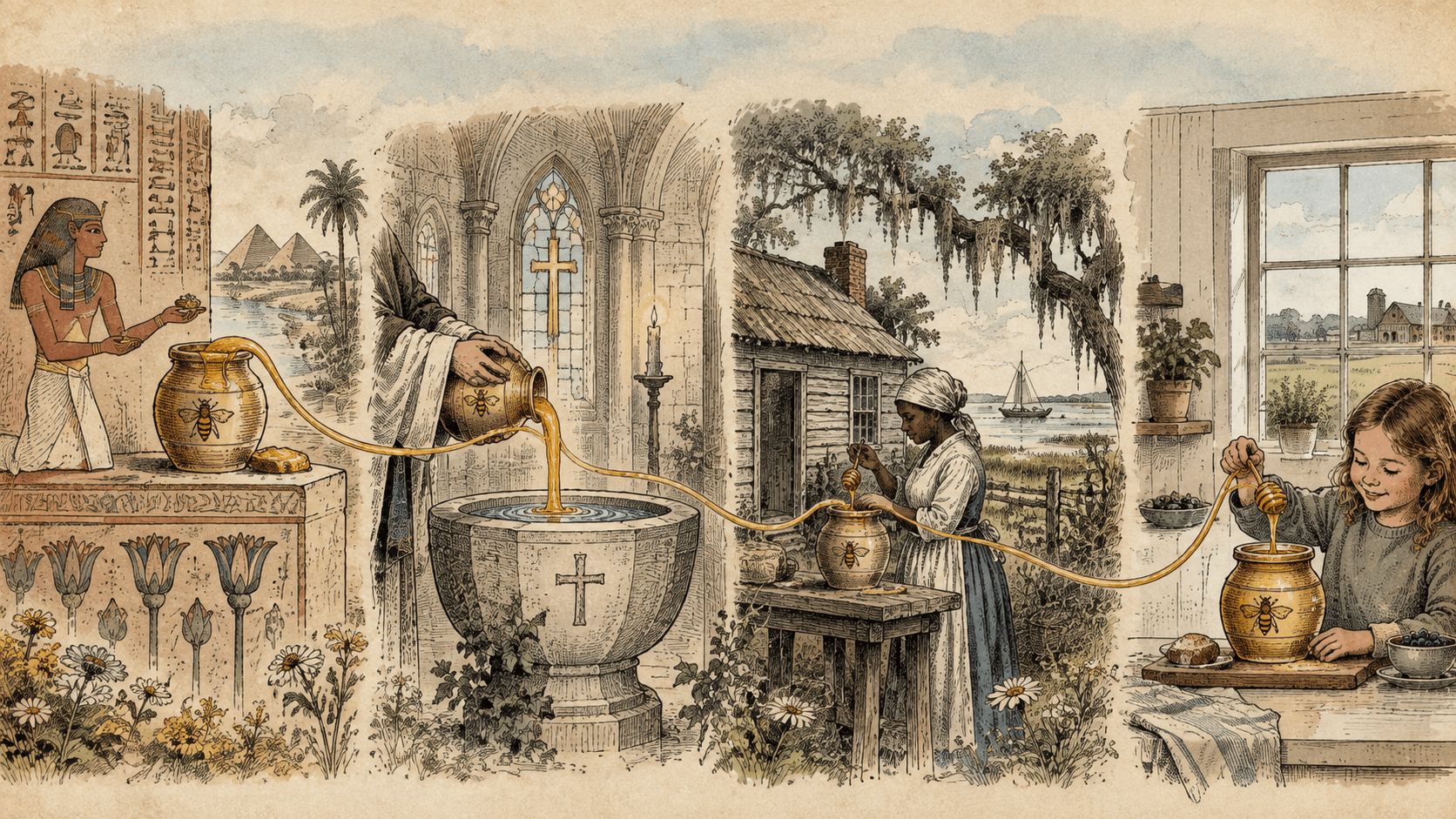
Casey starts this chapter from something ordinary: a honey jar that doesn't spoil, sitting in a kitchen cabinet the same way Egyptian tombs sealed it for pharaohs three thousand years ago, chemically unchanged both times. From there, the chapter argues that milk and honey aren't just old ingredients. They're one of the oldest paired images for crossing a threshold: an offering at Eleusis, a purification rite for Roman Mithraic initiates, a Hindu wedding sweet, and, closer to the church's own history, the cup handed to a newly baptized Christian in the Didascalia Apostolorum and the Canons of Hippolytus, meant to mark someone born again as a child. The Civil War thread carries the same image into American soil. Frederick Douglass wrote plainly that when enslaved singers repeated "O Canaan, sweet Canaan," they meant something more literal than heaven: the North was their Canaan, the land scripture itself describes as flowing with milk and honey. Missionaries collecting those songs on the Sea Islands during the war published them in 1867, in Slave Songs of the United States, without ever fully grasping what the people singing them meant to do about it. Casey's point isn't that these traditions borrowed from each other. It's that none of them had to. The same image kept surfacing on its own, in a Greek rite, a Roman cult, a church font, and a cotton field, because 1 Peter 2:2's picture (a newborn craving milk to grow) describes something true enough that it didn't need translating.
Bee Science
- Egyptian tomb honey's chemical incorruptibility
- honey sealed in Egyptian tombs over three thousand years ago has been found chemically intact — water content too low, sugars too concentrated, and natural hydrogen peroxide too hostile for anything to grow in it and spoil it
- Honey vs. other foods
- a sealed jar of honey sits unspoiled indefinitely, while bread molds in days and meat rots by morning
Scripture
Anchor: Romans 1:20
Also touches
Civil War Recordearly church
The early church's baptismal milk-and-honey rite (Didascalia Apostolorum & Canons of Hippolytus), set inside a cross-cultural threshold tradition
- The Didascalia Apostolorum and the Canons of Hippolytus, both from the church's first few centuries, describe a real baptismal rite: a newly baptized Christian, still dripping, was handed a cup of milk and honey, "to teach the communicants that they are born a second time as little children"
- Milk-and-honey as a threshold image surrounds that rite in other cultures: at Eleusis, milk (and honey with it) was a customary offering poured out for the gods and spirits believed to live beneath the earth; Roman Mithraic initiates had their hands purified with honey at the "Lion" grade, per the philosopher Porphyry; Hindu wedding and birth rites still use a honey-and-curds mixture called madhu-parka
- Two lesser-known ancient texts carry the same image: the Apocalypse of Paul (~4th century) has Paul meeting Isaiah, Jeremiah, Ezekiel, and other prophets at a river of honey; Joseph and Asenath (date debated, 1st century BCE-4th century CE) has a convert fed a honeycomb by the Archangel Michael, verified against E.W. Brooks's translation
- During the Civil War, Frederick Douglass wrote in his 1855 memoir that the spiritual "O Canaan, sweet Canaan, I am bound for the land of Canaan" meant more than heaven to those who sang it: "We meant to reach the North, and the North was our Canaan" — verified verbatim against My Bondage and My Freedom (1855)
- Missionaries and folklorists working among the newly freed people of South Carolina's Sea Islands during the war collected dozens of these songs, publishing them in 1867 as Slave Songs of the United States
Primary sources (4)
- Didascalia Apostolorum; Canons of Hippolytus (cross-checked via notes/research/sacred-bee-ransome.md)
- Porphyry, On the Cave of the Nymphs (Mithraic honey-purification at the "Lion" grade)
- Frederick Douglass, My Bondage and My Freedom (1855)
- Allen, W.F., Ware, C.P. & Garrison, L.M., Slave Songs of the United States (1867)
verified
From the Book
Giving honey away is just part of keeping bees, for me. Every Christmas, each of my five kids' teachers gets a jar, and by now all five expect it. When someone knocks on my door to drop something off, or just stops by to visit, more often than not they leave with honey too. Every year I still bring a jar to my best friend's parents. He passed away, but Tim, his dad, tells me every time how much it means to him. The memory that actually taught me what honey is for came before I ever kept a single bee of my own. The commercial beekeeper who'd kept his hives at the edge of our woods growing up gave us extra honey the year we told him we were moving, five full years before I caught my first swarm. And once, after I spoke at a church, I gave three pounds of it to a kid in the crowd who'd paid attention and answered every question I asked. The next time I came back to speak there, he handed me a drawing he'd made. It still hangs on my wall. Honey doesn't behave like other food. Leave bread out and it molds in days. Leave meat out and it rots by morning. But a sealed jar of honey just sits there, patient, unbothered by time in a way almost nothing else edible is. Archaeologists opening sealed jars in Egyptian tombs, some over three thousand years old, have found the honey inside chemically intact: its water content too low, its sugars too concentrated, its own natural hydrogen peroxide too hostile, for anything to grow in it and spoil it. Pharaohs were buried with it on purpose, provisions for a journey they believed was still ahead of them.
Get the full book →