© 2026 Casey Spitnale
Chapter 19
Be the Bee
A Call to Live for Others
“The bee is more honored than other animals, not because she labors, but because she labors for others.”
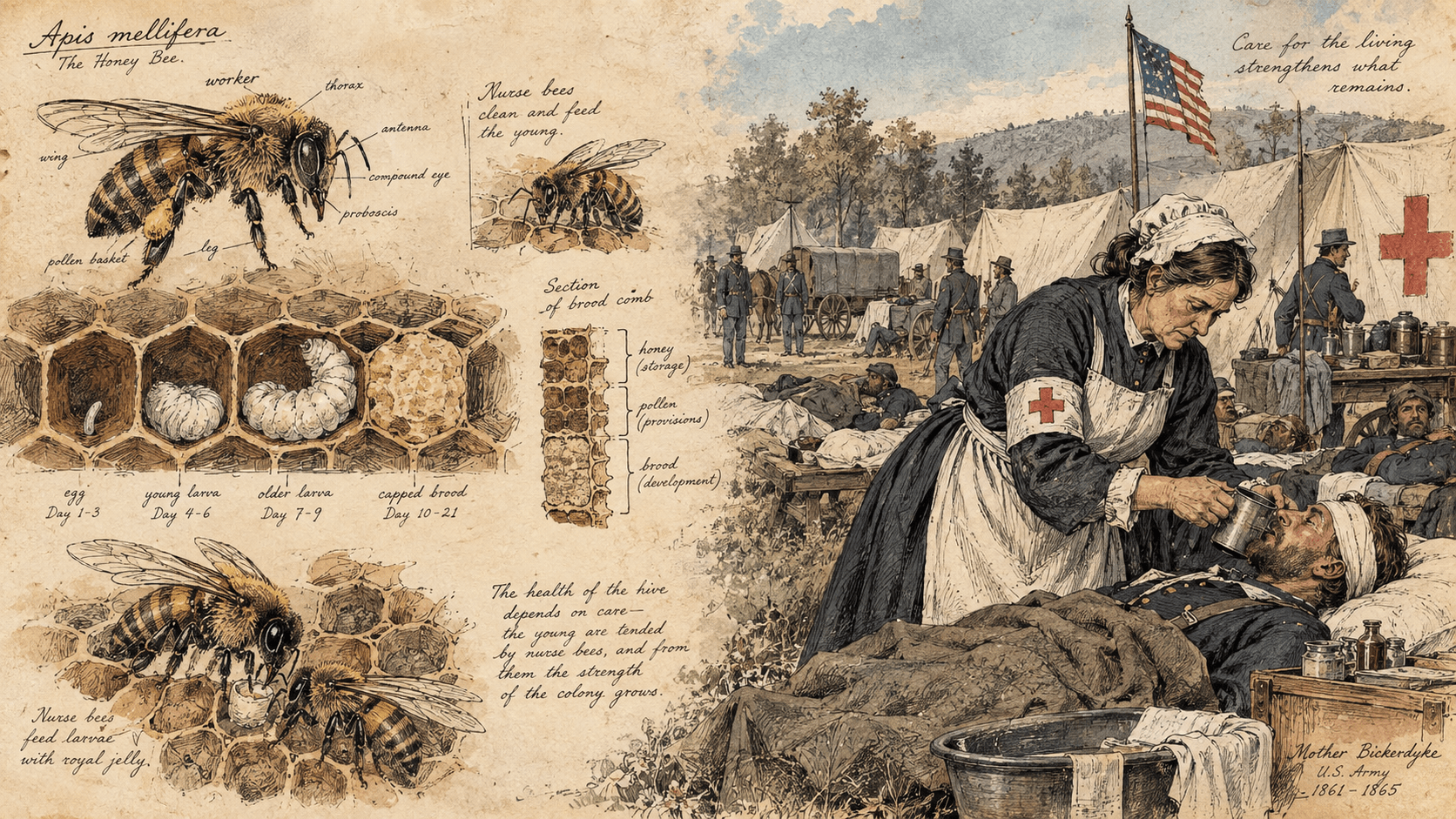
Casey's case in this chapter is that no bee in a hive works for herself, and that the colony's flexibility (young bees stepping up to forage the moment the older foragers are gone, older bees returning to nursing when the nurses disappear) only works because none of them are running a separate agenda. A sick forager doesn't even wait to be told. She leaves early and doesn't come back, protecting a colony she'll never see benefit from it. Casey sets that alongside two Civil War threads he keeps circling back to across the book: Mother Bickerdyke, who ran or set up some three hundred field hospitals and rode at the head of Sherman's corps in the Grand Review having earned it with no rank at all, and the men of the 54th Massachusetts, who refused eighteen months of pay rather than accept less than white soldiers, fighting for a freedom most of them expected to belong to people not yet born. Acts 2:44-45 describes the early church selling what it had and giving to whoever needed it. Casey reads the hive's own economy (nectar into honey, a strong colony's frame handed to a weak one only because a beekeeper chooses to move it) the same way: nothing in the system hoards, and nothing in the system is required to. The generosity still has to come from somewhere. That's the point, not the flaw. Someone has to choose to move the frame.
Bee Science
- Six weeks spent on needs that aren't hers
- each worker cleans cells she'll never live in, feeds larvae she'll never know as adults, builds comb she'll never use, and guards against threats that might never reach her
- Task flexibility on demand
- remove a colony's foragers and young bees start foraging weeks early; remove its nurses and older bees go back to nursing — the colony reassigns labor to whatever the whole needs
- Self-removal of sick foragers
- health-compromised foragers leave the hive early and don't come back — a self-removal the researchers read as protecting the colony from whatever the sick bee is carrying
- Beekeeper-assisted colony equalization
- left alone, a strong colony and a weak one don't share — a weak or queenless hive is more likely to get robbed by its stronger neighbors than helped by them; a beekeeper pulls a frame of capped honey and a frame of brood from the strong hive to even out what nature wouldn't
Cited research (4)
- Michener, C.D., The Social Behavior of the Bees (1974): standard comparative survey of bee societies, cited for reproductive division of labor — not, as an earlier draft wrongly implied, for detecting when collective survival depends on particular behaviors
- Robinson, G.E., Page, R.E., Strambi, C. & Strambi, A. (1992), "Colony integration in honey bees: mechanisms of behavioral reversion," Ethology 90: documents foragers reverting to nursing when a colony's nurses are removed
- Huang, Z.-Y. & Robinson, G.E. (1996), "Regulation of honey bee division of labor by colony age demography," Behavioral Ecology and Sociobiology 39: documents young bees foraging precociously when a colony's foragers are removed
- Rueppell, O., Hayworth, M.K. & Ross, N.P. (2010), "Altruistic self-removal of health-compromised honey bee workers from their hive," Journal of Evolutionary Biology 23: health-compromised foragers leave the hive early and don't return
Scripture
Anchor: Romans 1:20
Also touches
Civil War Recordcivil war
Mother Bickerdyke's battlefield nursing and the 54th Massachusetts's pay protest
- Mary Safford began nursing as soon as Union troops occupied Cairo, Illinois, in 1861, alongside Mother Bickerdyke, at a time when "there was no system, no organization, no knowledge what to do, and no means with which to work"; she funded hospital needs with her own money and her brother's, and after the battle of Belmont (November 1861) was the first out onto the field under fire, waving a handkerchief as a flag of truce (Livermore, My Story of the War, 1889, pp. 206-215)
- Mother Bickerdyke set up or ran roughly three hundred field hospitals over the course of the war, often arriving before the medical corps and staying after everyone else had left; at the Grand Review of the Armies in Washington, May 1865, General Sherman had her ride at the head of the 15th Corps
- The 54th Massachusetts, one of the first Black regiments organized in the North, protested unequal pay ($10/month versus white soldiers' $13) by refusing all pay for roughly eighteen months; Corporal James Henry Gooding wrote directly to Lincoln that September asking, "We have done a Soldier's Duty. Why can't we have a Soldier's pay?" — verified verbatim against the Freedmen and Southern Society Project's transcription (freedmen.umd.edu)
- Frederick Douglass's own sons, Charles and Lewis, served in the 54th Massachusetts
Primary sources (3)
- Mary A. Livermore, My Story of the War (1889), Ch. VIII, pp. 206-215 (Mary Safford) and Chs. XXIV-XXVII (Mother Bickerdyke)
- Freedmen and Southern Society Project, University of Maryland: Cpl. James Henry Gooding to Abraham Lincoln, Morris Island, S.C., Sept. 28, 1863 (freedmen.umd.edu/gooding.htm)
- Library of Congress, "The Civil War in America" exhibition biography; National Museum of Civil War Medicine, "'She Ranks Me': The Story of Mother Bickerdyke"
verified
From the Book
Mary Livermore described Mary Safford as "very frail, petite in figure as a girl of twelve summers, and utterly unaccustomed to hardship." Safford started nursing as soon as Union troops occupied Cairo, Illinois, in 1861, in the same hospitals Mother Bickerdyke was scrubbing into shape, at a time when "there was no system, no organization, no knowledge what to do, and no means with which to work." She bought what the hospitals lacked with her own money and her brother's. After the battle of Belmont that November she was the first one out onto the field, under guns that "ploughed the ground around her," and she tied her handkerchief to a stick, waved it over her head for a flag of truce, and went on with the wounded. The soldiers called her the Cairo angel. Livermore watched her find two men in a ward weeping because the surgeon had allowed them a tumbler of milk night and morning and the hospital had no money to buy it; Safford went out, caught the milk-woman in the street, paid for the day's milk herself, and told her to keep bringing it and send the bill to her. A captain of the 57th Illinois, wounded at Shiloh and carried aboard the hospital boat she was working, wrote that she "was everywhere, doing everything, straightening out affairs, soothing and comforting, and sometimes praying, dressing wounds, cooking and nursing, and keeping the laggards at their work. For herself, she seemed to live on air." She broke down completely before the war was two years old, spent months in a Paris hospital being treated for what the work had done to her, then came home and trained as a doctor (Livermore, My Story of the War, 1889).
Get the full book →