© 2026 Casey Spitnale
Chapter 18
The Hive's Risk
Faith in Action
“Deseret: A Beehive. May her inmates never cease their toil until the world is filled with honey, and her enemies with stings.”
Casey opens the chapter with an accident: a dropped frame, a jolt through the hive, guard bees stinging in seconds with no calculation involved. A worker's stinger is barbed. Once she uses it, she can't take it back, and she doesn't survive losing it. That single, irreversible commitment is what Casey lines up against Colonel Edward Baker riding into Ball's Bluff and Sergeant William Carney carrying the flag at Fort Wagner under fire that wounded him twice. The guard bee lives out Matthew 16:25 (whoever loses their life for something bigger finds it) without ever choosing it. Baker and Carney chose it, eyes open, the way John 12:24's kernel of wheat has to fall and die before it produces anything. Not every threat in the chapter looks like something a guard can meet at the entrance. Chalkbrood spread through Japan for years before anyone understood how it survived between outbreaks, and no sting stops a fungus. Casey reads that as its own kind of courage, the watchfulness 1 Peter 5:8 asks for against a threat that prowls rather than charges. The chapter's throughline lands on Daniel 3:17-18: Shadrach, Meshach, and Abednego telling Nebuchadnezzar their God could save them, but even if he doesn't, they still won't bow. That's the guard bee's clause too. She doesn't sting expecting to live. She stings because the colony behind her is worth more than the outcome in front of her.
Bee Science
- Sting autotomy
- a worker's barbed stinger anchors in the intruder, releasing venom and alarm pheromones; she can't withdraw it, and the loss of the stinger, venom sac, and part of her abdomen is a wound she doesn't recover from
- Alarm pheromone (isopentyl acetate)
- the "banana scent" released at a sting site calls other defenders to the same spot; the response runs to completion with no hesitation
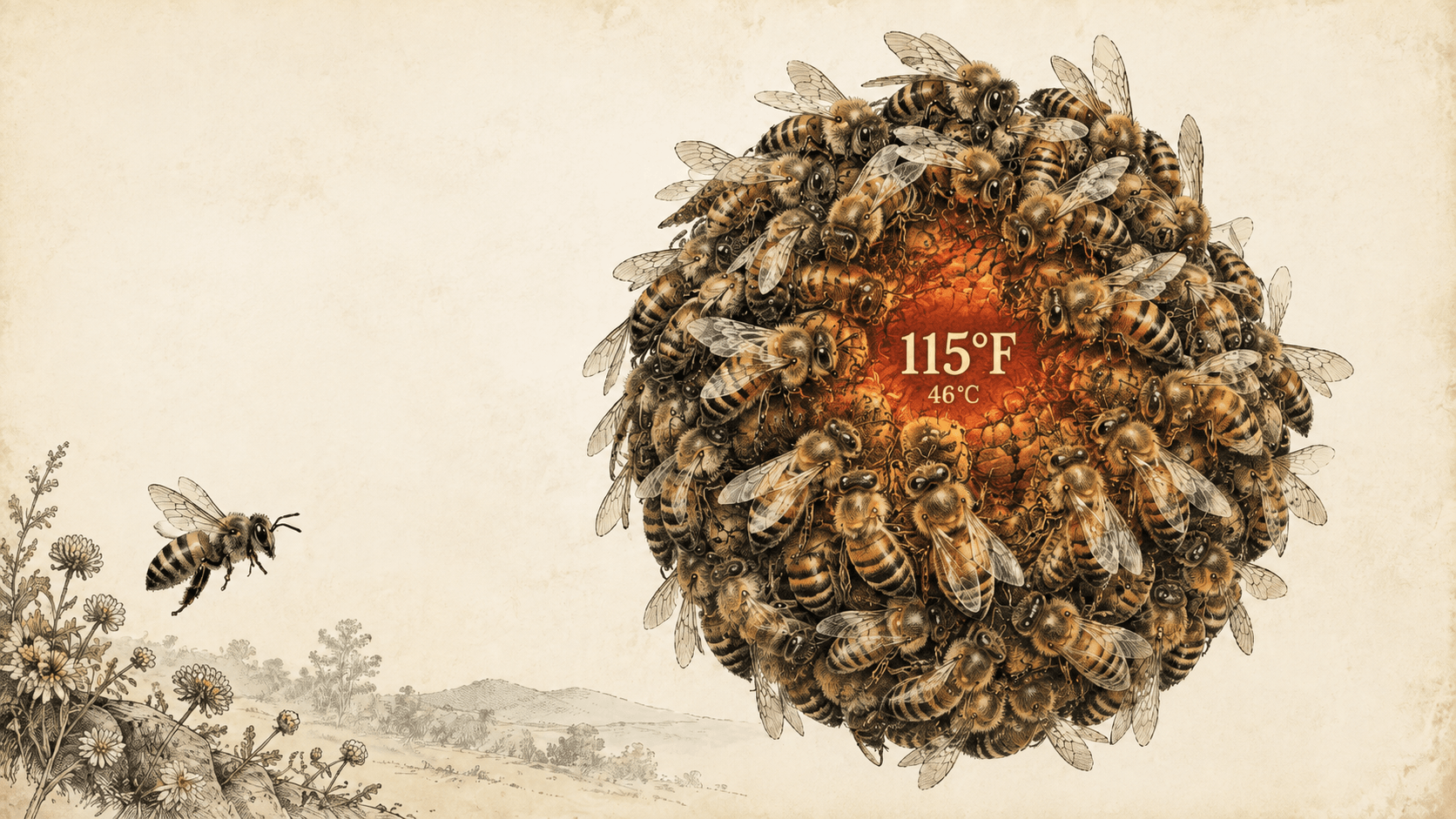
- Heat-ball defense
- a tight ball of workers smothers an attacking hornet with their own collective body heat; internal temperatures measured well above 110°F, hot enough to kill the hornet along with some defenders — most thoroughly documented in Japanese honeybees (Apis cerana japonica) against giant hornets; Casey's own bees are a different species but share the mobbing instinct at a smaller scale
- Chalkbrood's spread in Japan
- the fungus was first isolated there in 1974 from imported honey, an outbreak confirmed in 1979, and by 1982 it was established on three islands with no cure and almost nothing known about how it lived in the wild
Cited research (3)
- Boch, R., Shearer, D.A. & Stone, B.C. (1962), "Identification of Isoamyl Acetate as an Active Component in the Sting Pheromone of the Honey Bee," Nature 195:1018-1020: identified isopentyl (isoamyl) acetate as the sting alarm pheromone — the real source behind this chapter's "banana scent" detail and ch.9's parallel claim
- Papachristoforou, A. et al. (2007), Current Biology: documents A. mellifera cypria balling and heat-killing Vespa orientalis hornets, backing the claim that Casey's own (different) species shares the mobbing/heat-ball instinct
- Furuya (1982), Honeybee Science (Mitsubachi Kagaku, Tamagawa University): Japanese-language mycology review tracking chalkbrood's 1974-82 spread through Japan; read via the author's own English summary, no direct quotes available
Scripture
Anchor: Romans 1:20
Also touches
Civil War Recordcivil war
Colonel Edward D. Baker at Ball's Bluff and Sergeant William Carney at Fort Wagner
- Colonel Edward D. Baker, the only sitting U.S. Senator ever to die in combat, led roughly 1,700 Union soldiers across the Potomac at Ball's Bluff, Virginia, on October 21, 1861, into a tactically disadvantageous position against a superior Confederate force
- Baker's attested remarks hold up under verification: that the officer who dies with his men will never be harshly judged, and, to a soldier who suggested he take cover, that once you're a United States senator, you won't lie down either; he was struck by several bullets, including a fatal shot to the head, per Captain Francis Young's account, preserved in the Official Records of the war
- Sergeant William H. Carney, 54th Massachusetts Infantry, was the first African American soldier whose actions in combat were recognized with the Medal of Honor, awarded May 23, 1900, for the July 18, 1863 assault on Fort Wagner, South Carolina
- Carney's actual Medal of Honor citation reads: "When the color sergeant was shot down, Sergeant Carney grasped the flag, led the way to the parapet, and planted the colors thereon. When the troops fell back he brought off the flag, under a fierce fire in which he was twice severely wounded." His remembered remark, "Boys, I only did my duty; the old flag never touched the ground," is the line his name has carried since, not itself part of the citation text; The Liberator carried word of his courage that same August 1863
Primary sources (3)
- Congressional Medal of Honor Society, recipient page for William Harvey Carney (cmohs.org/recipients/william-h-carney)
- Official Records of the War of the Rebellion (Captain Francis Young's account of Baker's death at Ball's Bluff)
- The Liberator, August 1863
verified
From the Book
On a warm summer day, I accidentally dropped a frame heavy with honey during inspection, sending a vibration through the entire hive that triggered an instantaneous defensive response. Within seconds, dozens of guard bees rushed toward the perceived threat, their wings humming with purpose, alarm pheromones filling the air with the scent of banana. Several workers plunged their stingers into my gloves, giving their lives to defend their sisters and queen from what they took for an attack on their home. Danger doesn't make a hive flinch. It makes a hive commit, immediately and totally. When a worker bee stings a threat to the colony, her barbed stinger anchors in the intruder's flesh, releasing venom and alarm pheromones that call other defenders to the same spot. As she pulls away, the stinger stays behind with the venom sac and part of her abdomen still attached, a wound she doesn't recover from. Despite that price, guard bees don't hesitate when the colony needs protecting. The response holds even against threats many times a single bee's size, and it has held generation after generation. This sacrificial protection brings to mind Colonel Edward D. Baker's extraordinary stand at Ball's Bluff during the Civil War. Baker, the only sitting U.S. Senator ever to die in combat, led roughly 1,700 Union soldiers across the Potomac River on October 21, 1861, where they were met by a superior Confederate force in a tactically disadvantageous position. When urged to fall back, Baker is remembered as saying that the officer who dies with his men will never be harshly judged, and reportedly told one soldier who suggested he take cover that once you're a United States senator, you won't lie down either.
Get the full book →