© 2026 Casey Spitnale
Chapter 17
The Silent Symphony
Feeling God's Voice
“There is the hum of contentment and the hum of trouble, the hum of peace and the hum of defence, the hum of plenty and the buzz of starvation, the hum of joy and the roar of grief, the cry of pain and the music of their dance.”
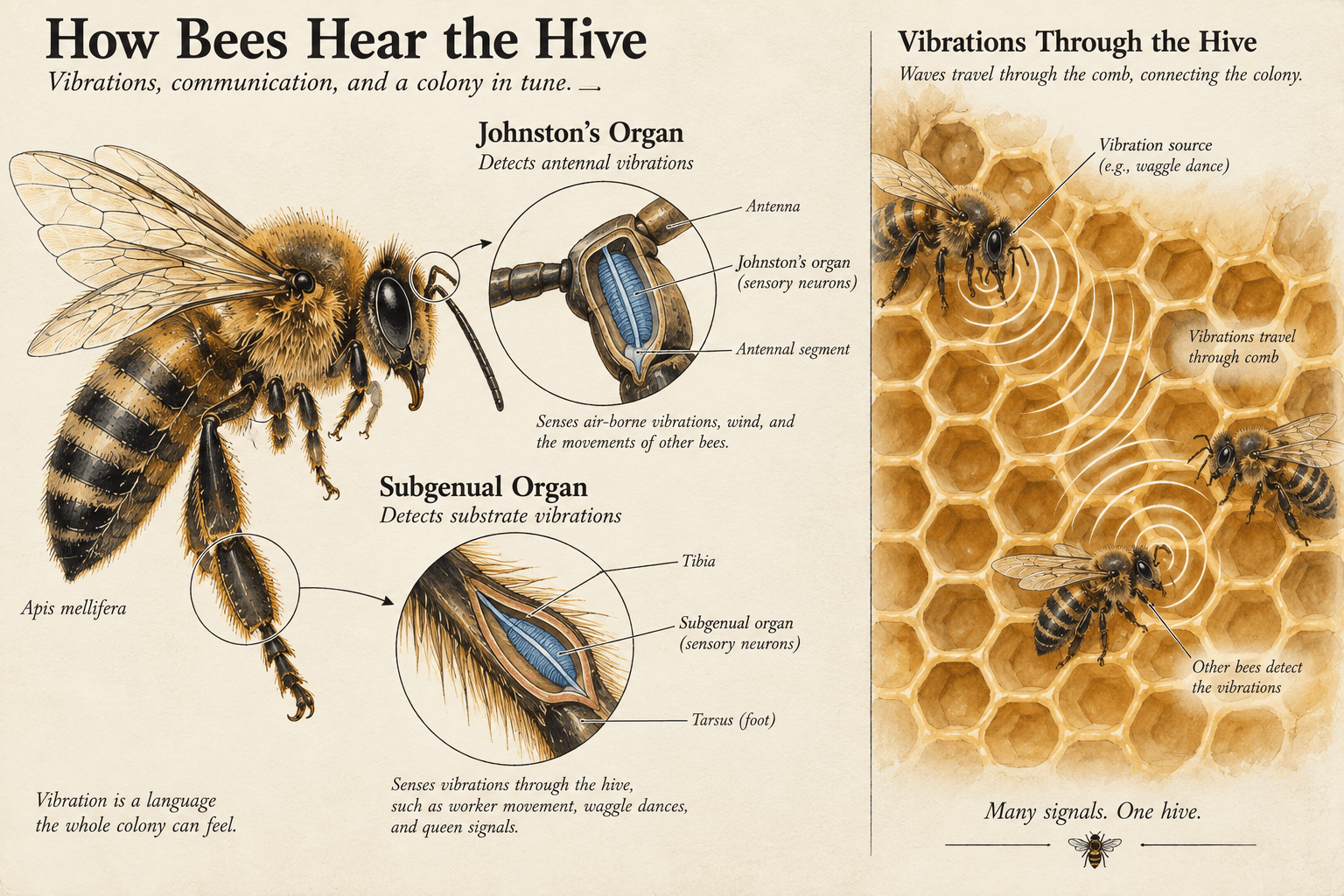
Casey builds the chapter around one question: what does it take to actually notice a signal that's already there? Bees never evolved ears built for distance. Johnston's organ only picks up air moving close around a bee's own body, tuned near the frequency of her own wingbeat. Anything farther off has to travel a different way, through the comb and up through the subgenual organs in her legs. Casey sets that against A.E. Lundie's 1922 flight counts: a colony emptying the field hours before a storm that built all afternoon and never broke, and an undisturbed hive's own flight counts spiking forty percent the moment a colony thirty-six feet away was disturbed. Nothing in either hive was built to hear that far. Something in the colony still read it. Edward Porter Alexander's wig-wag warning at First Manassas makes the same point. Nobody down on the field could see what he saw from his signal-station hilltop. He was positioned to notice, and trained to get the warning across before the moment closed. That's the pivot into 1 Kings 19, where God turns up not in the wind, the earthquake, or the fire, but in a whisper only after all three have passed. Elijah had to learn to expect that. Samuel, back in 1 Samuel 3, needed three tries before Eli understood what was happening and told the boy what to say. Casey's point isn't that God is quiet by nature. It's that most of what matters comes in at a scale too small for someone still listening for something loud.
Bee Science
- Johnston's organ hearing range
- a narrow slice of near-field airborne sound, tuned to roughly 250-350 Hz — close to a bee's own wingbeat and waggle-dance frequency
- Subgenual organs (leg vibration sense)
- sensors just below the knee joint of each leg detect vibration traveling up through the comb — a bee's channel for anything farther off than close-range sound
- 1922 threatened-storm response
- at the height of an afternoon storm that built, thundered, and never dropped a drop of rain, all but thirteen of the bees out foraging had come home, hours before weather a person would have run from
- 1922 neighbor-disturbance spike
- when a colony 36 feet away was disturbed until the air over it was as thick with bees as a swarm on the wing, an undisturbed hive's own flight counts spiked about 40% above normal, ingoing and outgoing both, at the same moment
Cited research (5)
- Dreller, C. & Kirchner, W.H. (1993), "Hearing in honeybees: localization of the auditory sense organ": established Johnston's organ, in the antennae, as the site of airborne-vibration detection
- Tsujiuchi, S. et al. (2007): found antenna/Johnston's-organ neurons tuned to 250-300 Hz, matching waggle-dance frequency
- Sandeman, D., Tautz, J. & Lindauer, M. (1996), "Transmission of vibration across honeycombs and its detection by bee leg receptors," Journal of Experimental Biology: documented leg-receptor (subgenual organ) detection of comb-transmitted vibration
- Lundie, A.E., USDA Bulletin 1328 (1925), The Flight Activities of the Honeybee: electric-gate flight counters on a Maryland colony (1922) recorded the storm-response and neighbor-disturbance spikes; Lundie's own line: "it is interesting to speculate as to the method of conveyance of the information to the bees within the experimental colony"
- Tautz, J., The Buzz about Bees (2008): describes the honeycomb itself as a communication medium, carrying vibrations through wax at frequencies close to a bee's own wingbeat
Scripture
Anchor: Romans 1:20
Also touches
Civil War Recordcivil war
Edward Porter Alexander's wig-wag warning at First Manassas, July 21, 1861
- Alexander, a young Confederate officer, had trained under Albert J. Myer, inventor of the U.S. Army's new "wig-wag" flag-signaling system — a method almost nobody yet trusted in actual combat
- Posted on a signal station hilltop at the First Battle of Manassas (Bull Run), July 21, 1861, Alexander caught a glint of sunlight on distant metal and made out a Union column moving to outflank the Confederate left, a threat the generals on the ground couldn't yet see
- He wig-wagged the warning across the field — remembered as "Look out for your left; you are turned" — giving Confederate commanders time to shift their line before the flanking blow landed; it's remembered as the first tactical use of flag signaling in American combat
- The exact wording of the signal varies slightly across period and secondary sources ("Look out for your left, your position is turned" / "Look to your left, you are turned"), which is normal for a widely-quoted 1861 battlefield signal, not a sign of fabrication
- An earlier draft's version of this anecdote (a fabricated "knock code" episode) has been fully replaced by this verified First Manassas story; no trace of the fabricated version remains in the live manuscript text (confirmed 2026-09-09 and again 2026-09-16)
Primary sources (1)
- notes/research/citation-fixes-2026-09-09.md (2026-09-09 verification pass): confirms Alexander trained under Myer, was posted on Signal Hill at First Manassas, and signaled a warning to Col. Nathan Evans
verified
From the Book
The boy Samuel heard his name three times in the night before anyone in the house understood what was calling him. Twice he ran to Eli, the old priest lying in his usual place, and twice Eli sent him back to bed. It was only on the third time that "Eli realized that the Lord was calling the boy," and he told him what to say if it happened again: "Speak, Lord, for your servant is listening" (1 Samuel 3:8-9). The priest, who had spent his life in that house, wasn't the one who heard. The voice came through the one person in the building who was still listening. Bees have no ears like ours, no eardrum, no cochlea, but that doesn't mean they live in silence. They hear a narrow slice of the world through Johnston's organs, a cluster of sensors packed into their antennae that detect the faintest movement of air right around them, tuned almost exactly to the frequency of their own wingbeats and their own waggle dance, somewhere in the range of 250 to 350 Hz (Dreller & Kirchner, 1993; Tsujiuchi et al., 2007). That's close-range hearing, built for a world where the only sounds worth catching are the ones a sister makes a few inches away. For anything farther off, they switch senses entirely, feeling vibration travel up from the comb through their legs, by way of subgenual organs, sensors tucked just below the knee joint of each leg. A bee doesn't hear a warning from across the hive so much as feel it arrive through the floor she's standing on.
Get the full book →