© 2026 Casey Spitnale
Chapter 16
The Bee's Body
Clothed in God's Armor
“Go to the bee, thou poet: consider her ways and be wise.”
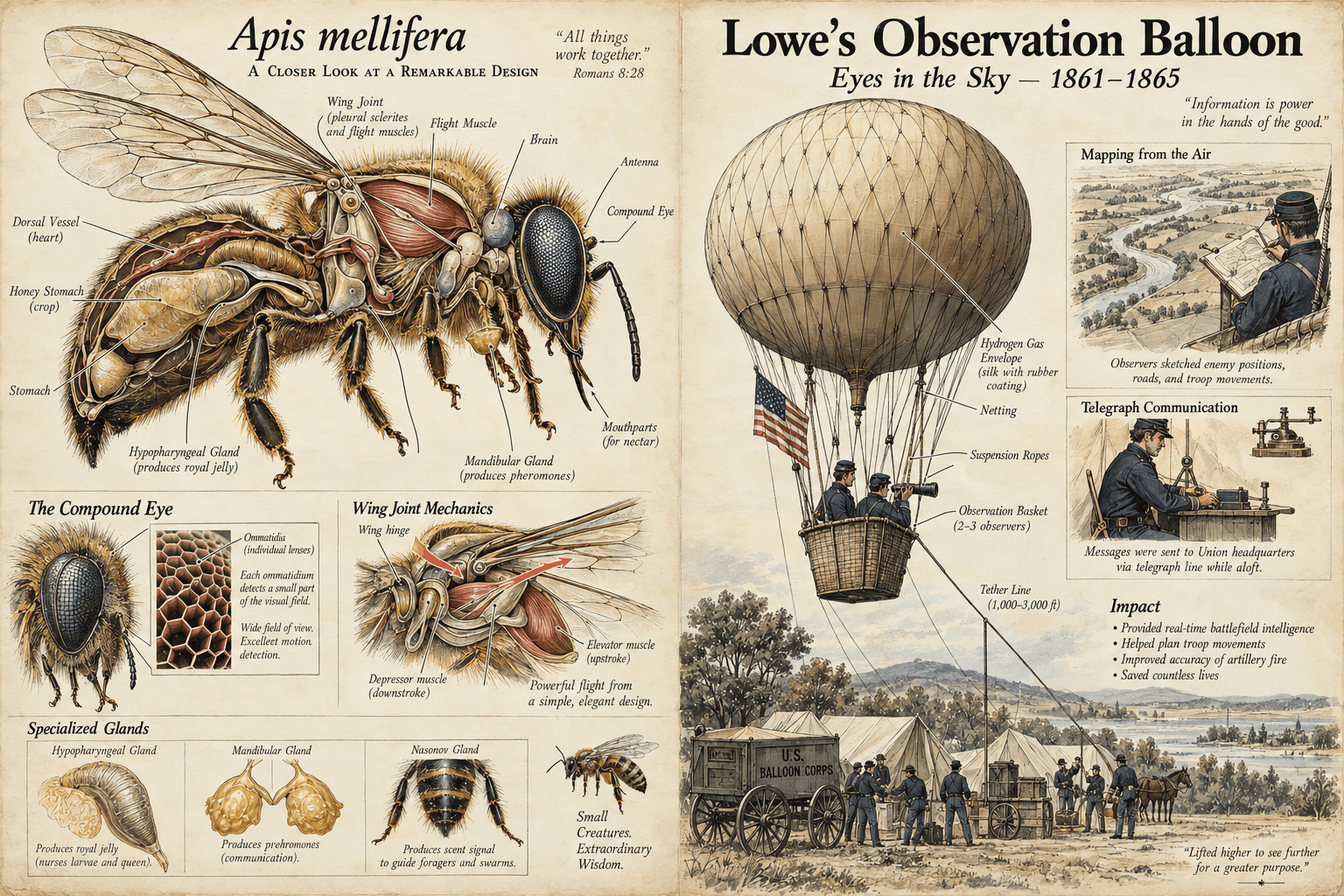
Thaddeus Lowe's balloon corps worked because it was never just a balloon. Portable hydrogen generators, an observation platform, and a telegraph line back to headquarters had to function as one integrated system before Lowe's aerial view at Fair Oaks meant anything on the ground. Take away any one piece and the intelligence never reaches the army in time to matter. Casey builds the chapter's anatomy section the same way. A bee's two compound eyes, each with up to 6,900 lenses, work alongside three simple eyes on top of her head that read light levels and keep her steady in flight: five eyes, not two, each doing a different job. Her antennae carry more than 170 odor receptors. None of those parts protects her on its own. They function as a single system, the same way Lowe's generators and gasbags and telegraph wire only mattered together. That's the shape Casey finds in Ephesians 6:10-18's full armor of God: not one piece of equipment but a complete system, belt and breastplate and shield and sword, meant to be worn as a whole. A bee doesn't get to rely on her eyes alone or her wings alone. She's covered, part by part, into one working design, and Casey reads that completeness as the point Paul was making too: armor only protects when none of it is missing.
Bee Science
- Eyes
- two compound eyes with up to 6,900 individual lenses apiece, plus three simple eyes (ocelli) in a triangle atop the head that read light levels and help her hold steady in flight: five eyes, not two
- Antennae
- more than 170 odor receptors per antenna, distinguishing thousands of floral scents and a shared colony chemical signature
- Wingbeat frequency
- 230 wingbeats per second, via an indirect flight-muscle system unlike bird or bat flight
- Colony thermoregulation
- bees shiver their flight muscles without moving their wings ('endothermy on demand'), holding the brood nest between about 91-97°F regardless of outside temperature
Cited research (3)
- Snodgrass, R.E., Anatomy of the Honey Bee (1956): First comprehensive anatomical map of the honey bee; underlies the chapter's anatomy tour, including the ocelli
- Stabentheiner, A., Kovac, H. & Brodschneider, R. (2010), "Honeybee colony thermoregulation," PLoS ONE 5:e8967: Colony-level endothermy: shivering flight muscles hold the brood nest at a stable temperature independent of outside weather
- Furuya, Kouhei (1982), Honeybee Science (Mitsubachi Kagaku) 3(2): Chalkbrood fungus (Ascosphaera), found nowhere but bee nests, grows and fruits best near the temperature and sugar concentration a colony holds its brood nest to; worked from the author's English summary and numeric tables, no direct quotes (Japanese-language paper)
Scripture
Anchor: Romans 1:20
Also touches
Civil War Recordcivil war
Thaddeus Lowe and the Union Army's Balloon Corps
- Lowe demonstrated military ballooning to Lincoln on June 16, 1861 (per Library of Congress dating), ascending 500 feet above Washington and transmitting the first telegram ever sent from an aerial station
- When military bureaucracy stalled Lowe's formal appointment, Lincoln personally intervened with a July 25, 1861 note to Gen. Winfield Scott: 'Will Lieut. Genl. Scott please see Professor Lowe, once more about his balloon.' Lowe was appointed Chief Aeronaut of the Union Army's new Balloon Corps later that summer
- Lowe developed portable, wagon-mounted hydrogen generators for rapid field deployment; his technical drawings are preserved in the Smithsonian Institution Archives, and Joseph Henry sponsored the work
- At the Battle of Fair Oaks (May 31, 1862), Lowe's aerial observations spotted Confederate troop movements bearing down on an isolated Union wing, intelligence credited with saving that part of the army from disaster
- During the same campaign, Brig. Gen. Fitz John Porter's tether snapped during a reconnaissance ascent and he drifted over enemy lines, continuing to sketch enemy positions until a wind shift let him valve gas and descend safely back over Union territory
Primary sources (4)
- Lincoln Papers, Library of Congress (June 16, 1861 telegram; July 25, 1861 note to Scott)
- Lowe's official report, Official Records, Series III, Vol. 3
- Smithsonian Institution Archives (Lowe's technical drawings)
- notes/chapters/citations.md, Ch.16 section
verified
From the Book
A bee's body teaches us divine craftsmanship on a miniature scale. One tranquil summer afternoon, I carefully scooped an exhausted forager from my hive's landing board, her wings frayed from thousands of flights, legs still dusted with pollen. As she rested in my palm, I marveled at this tiny creature weighing less than a tenth of a gram yet engineered with a precision I still can't get over. With compound eyes containing thousands of individual lenses, antennae sensitive enough to pick one flower's scent out of a whole field, and a flight system that defies conventional aerodynamics, she embodies a design so intricate it could only come from the Master Creator. Now, as a beekeeper, I find each close examination reveals new evidence of God's meticulous attention to even His smallest creations. The bee's body divides into three distinct segments, each a masterpiece of specialized design. The head houses two compound eyes with up to 6,900 individual lenses apiece that can detect ultraviolet patterns invisible to humans, guiding them to nectar sources we cannot see without special equipment, plus three simple eyes, the ocelli, set in a triangle on top of the head to read light levels and help her hold steady in flight. Five eyes, not two. Their antennae contain over 170 different odor receptors, allowing them to distinguish between thousands of floral scents and recognize their own colony's members by a shared chemical signature.
Get the full book →