© 2026 Casey Spitnale
Chapter 15
Propolis
Armor Against Evil
“A kind of cement used in hives to fill up all holes and cracks, and prevent unnecessary ventilation... a sort of resin or gum, sometimes called bee-glue... collected from the buds of poplar and other trees.”
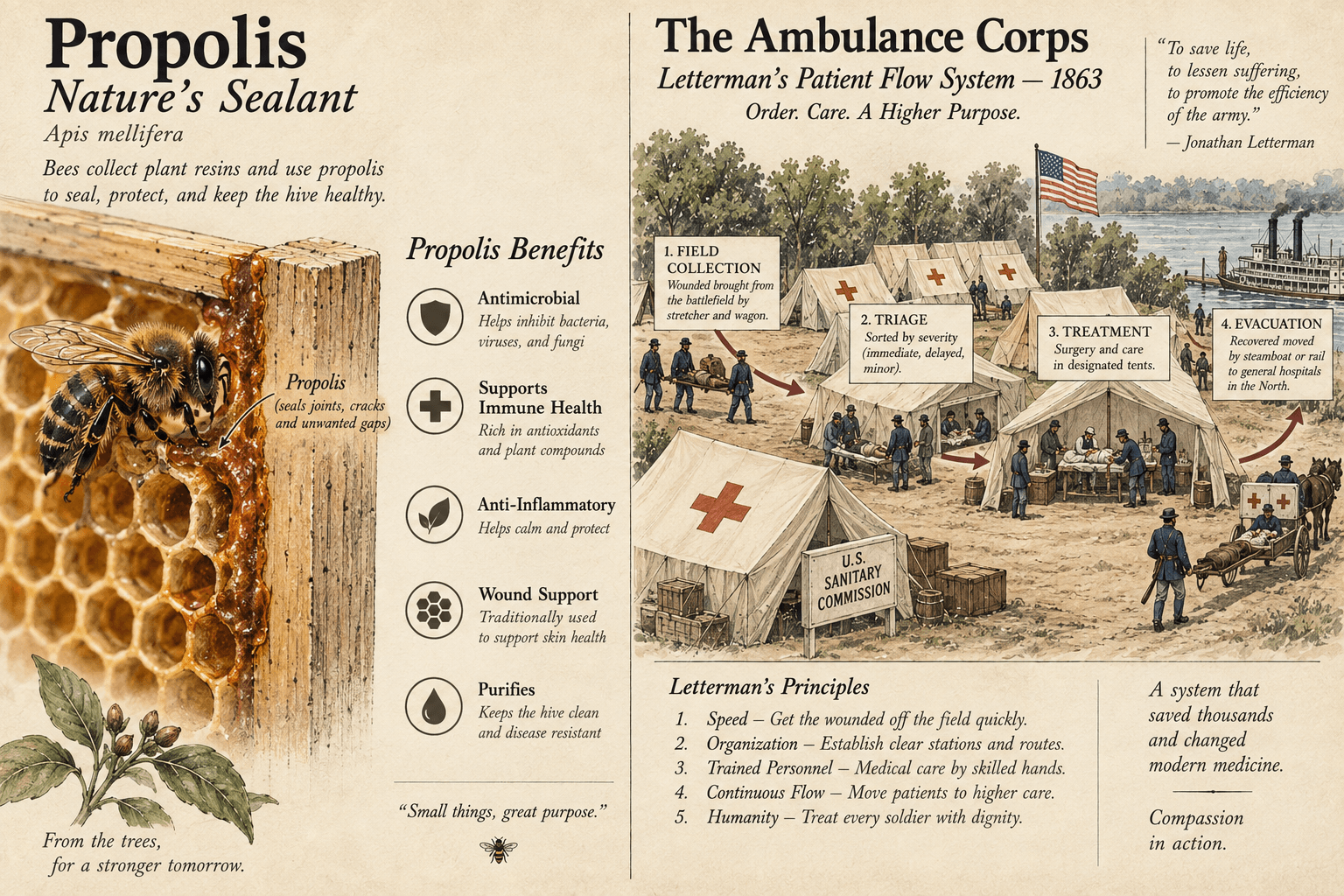
Propolis doesn't act like a wall so much as a nervous system for the whole colony. Colonies coated in it show lower individual immune-gene activity than colonies without it, meaning the protection is working at the level of the hive, not bee by bee. No single bee has to fight off more because the colony built the defense in ahead of time, into every seam and crack. Casey draws the same shape out of Jonathan Letterman's ambulance system. Before Letterman's reforms, wounded men could lie on a battlefield for days waiting for help that didn't exist yet as an organized thing. Three weeks after General Orders No. 147 created the Army of the Potomac's first real ambulance corps, Antietam produced more than 23,000 casualties, and nearly every wounded man was off the field within about a day. No soldier got braver in those three weeks. The system around him changed, and that change protected men individually who never did anything differently themselves. That's the case Casey makes from Ephesians 6:16 and the shield of faith: protection isn't always something you can see doing its work, or something that only shows up in the moment of attack. Elisha's servant needed his eyes opened just to notice the protection that already surrounded him. A hive sealed in propolis, an army with an evacuation system in place, a servant standing in a ring of fire he can't yet see: none of them fought harder. They were already covered.
Bee Science
- Propolis compounds identified
- more than 300 chemical compounds, including antimicrobial flavonoids like pinocembrin and galangin
- Social immunity
- colonies coated in a natural propolis envelope show lower individual immune-gene activity than colonies without one
- Antimicrobial targets
- propolis flavonoids demonstrate potent antimicrobial effects against pathogens including Staphylococcus aureus and Candida albicans
Cited research (1)
- Simone-Finstrom, M., Evans, J.D. & Spivak, M. (2009), "Resin Collection and Social Immunity in Honey Bees," Evolution 63(11):3016-3022: Propolis-coated colonies show lower individual immune-gene activity than uncoated colonies, the paper's actual 'social immunity' finding; corrects an earlier manuscript misattribution to 'Apidologie, 2010' (notes/research/citation-fixes-2026-09-09.md)
Scripture
Anchor: Romans 1:20
Also touches
Civil War Recordcivil war
Jonathan Letterman's Civil War ambulance and evacuation system
- Letterman was appointed Medical Director of the Army of the Potomac in summer 1862 (orders June 23, duties from July 1); after the Second Battle of Bull Run (Aug. 29-30, 1862), wounded soldiers lay unattended on the field for days under the prior, ad hoc system
- General Orders No. 147, Army of the Potomac (August 2, 1862), created the first organized ambulance corps in American military history, with dedicated vehicles and trained personnel
- At Antietam (Sept. 17, 1862), barely three weeks later, nearly every wounded man among more than 23,000 casualties was cleared from the field within about 24 hours; the days-long horror of unattended wounded belongs to Second Bull Run, before Letterman's system existed, not to Antietam itself
- By the Battle of Fredericksburg that December, the ambulance corps evacuated roughly 9,000 wounded men in about twelve hours
- Over the war, Letterman's staged system of triage, evacuation, and standardized field hospitals is credited with helping bring Union died-of-wounds mortality down from around 25.6% early in the war to about 13.3% after his reforms took hold
Primary sources (3)
- General Orders No. 147, Army of the Potomac (August 2, 1862)
- Jonathan Letterman, Medical Recollections of the Army of the Potomac (1866)
- notes/chapters/citations.md, Ch.15 section
verified
From the Book
The first time I encountered propolis, I was struggling to pry apart two hive boxes that seemed impossibly fused together. When they finally separated with a sticky snap, I noticed reddish-brown material lining the seams and corners. It clung to my fingers with stubborn tenacity, releasing a sharp, resinous fragrance that reminded me of pine forests. I actually learned what it was from Marc, and not through any big reveal, just an offhand comment one day about why my boxes kept sticking together at every seam. That was propolis, he told me, and once I had the word I started noticing that dark, resinous seal everywhere in the hive. Years later I made a propolis tincture for my daughter's allergies. It's worked so well that she doesn't need allergy medicine anymore. Once I saw how much better it worked for her than honey ever had, I was determined to make her a real batch, so my son Harrison and I spent an hour harvesting clean propolis off some boxes I had sitting in storage. Wax isn't the only thing a bee builds with. Propolis represents one of God's most remarkable designs in creation, a shield that guards the hive from unseen dangers.
Get the full book →