© 2026 Casey Spitnale
Chapter 14
Pollen
Energy for the Journey
“They go out of the hive empty and return with their legs and wings laden with honey and bee bread.”
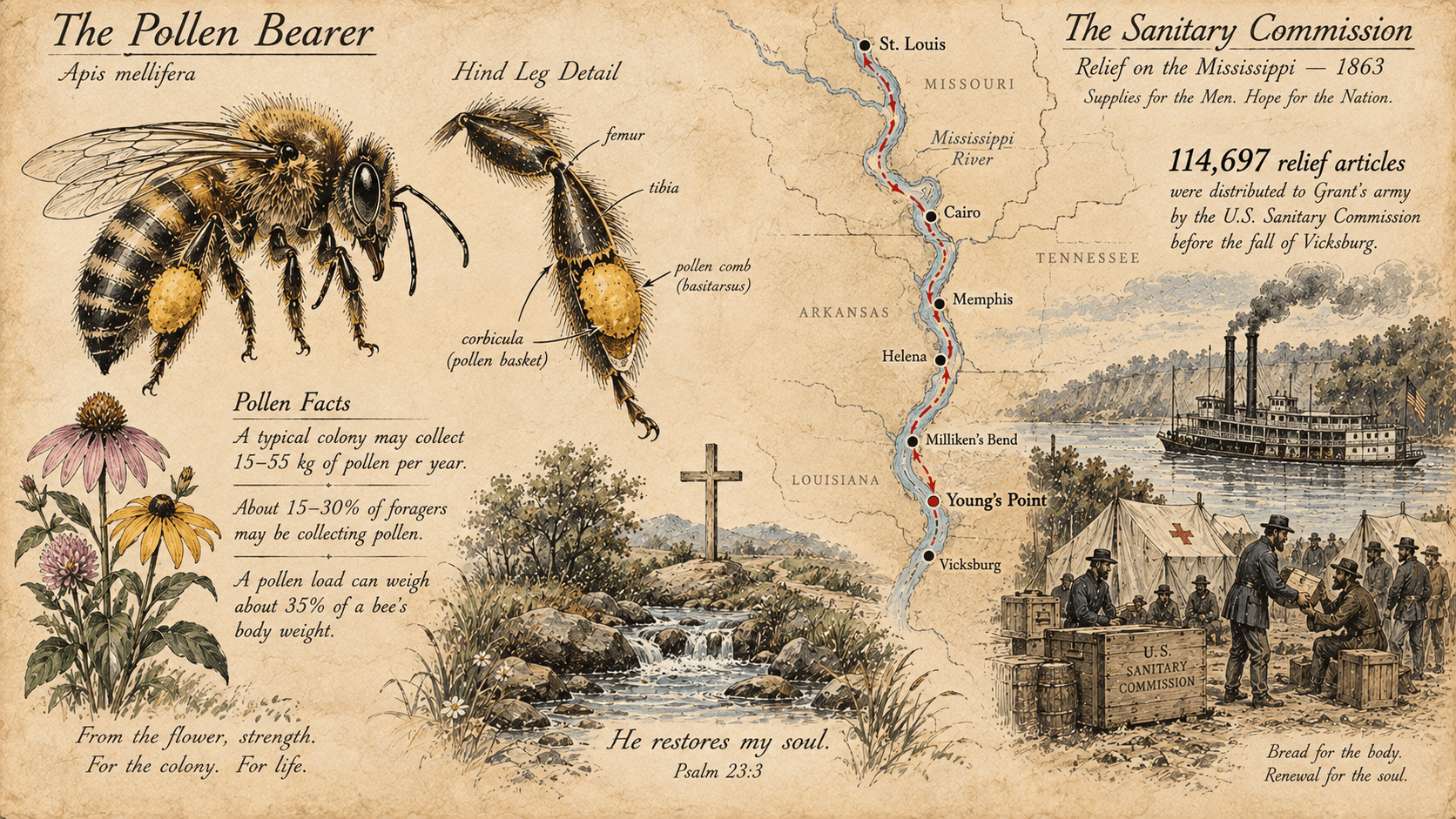
A hive can be full of honey and still starve. Pollen is the colony's only protein source, and no amount of stored sweetness substitutes for it: colonies increase or decrease their pollen foraging based on exactly how much protein is already stored, adjusting the one input that can't be swapped for another. Casey's chapter reads that as more than a foraging fact. It's the shape of a specific kind of need, one that no general abundance can fill. The historical anchor makes the same point on a larger scale. During Grant's siege of Vicksburg, thousands of Union soldiers went down with scurvy, a specific deficiency, not a general lack of food or effort. Mary Livermore and the U.S. Sanitary Commission traced the cause and sent boxes of potatoes, onions, and vegetables down the Mississippi. The men didn't need more rations. They needed the one specific thing rations didn't supply, and it had to arrive from outside the siege lines, gathered and shipped by people who never met them. That's what Casey ties to Psalm 23:3, being refreshed and led along the right path. Refreshment there isn't a mood. It's a specific provision meeting a specific need, whether that need is protein for a hive or the exact thing a besieged army's rations couldn't supply. The relief doesn't come from trying harder inside the shortage. It comes from outside it.
Bee Science
- Annual pollen collection
- a typical colony collects 33 to 88 pounds a year, depending on surroundings (corrected 2026-09-09 from an earlier, too-high 55-110 lb figure)
- Colony-level pollen regulation
- colonies increase or decrease pollen collection based on how much is already stored, a colony-wide response built from individual foragers adjusting their own effort, not foragers consciously targeting a protein percentage
- Bee bread fermentation
- lactic acid bacteria carried in the bees' own honey stomachs ferment stored pollen into 'bee bread,' a more digestible form storable for months
- Almond monoculture risk
- California's almond orchards cover about 1,200 square miles, bloom for roughly a month, and draw in a huge share of the country's commercial hives to work one pollen source for weeks on end
Cited research (3)
- Fewell, J.H. & Winston, M.L. (1992), Behavioral Ecology and Sociobiology 30:387-393: Colonies regulate pollen foraging at the colony level based on internal protein/stored-pollen needs, not through individual foragers targeting a protein percentage
- Vásquez, A. & Olofsson, T.C. (2009), Journal of Apicultural Research 48(3):189-195: Identified the honey-stomach-borne lactic acid bacteria that ferment pollen into bee bread
- Marra (2014), Colony Collapse Disorder in North American Honey Bees (thesis), drawing on Jacobsen, Fruitless Fall: Almond-orchard pollination monoculture and corn-syrup overwintering as protein-deprivation risks
Scripture
Anchor: Romans 1:20
Also touches
Civil War Recordcivil war
Mary Livermore, the U.S. Sanitary Commission, and the scurvy crisis at the Vicksburg siege, winter 1862-spring 1863
- During Grant's siege of Vicksburg, Union engineers cut the Mississippi's levees; the resulting flood left thousands of men living in swamps and boats, and Mary Livermore recorded 'twelve thousand men lay sick at one time, about thirty-three and one-third per cent of the army at that point' (My Story of the War, p.281)
- The U.S. Sanitary Commission and the Chicago Board of Trade sent roughly 3,500 boxes and packages of relief supplies down the Mississippi in March 1863: 'potatoes, onions, sauer-kraut, and vegetables, chiefly for the scorbutic patients, who constituted a majority of the sick' (p.283)
- Livermore's relief party delivered word of the shipment to the besieging force at Milliken's Bend, and the sick began recovering almost as soon as the crates were opened (pp.298-300)
- The popular 'potato fleet' story (Livermore personally persuading Grant, soldiers reviving under 'an avalanche of vegetables') does not appear anywhere in Livermore's 720-page memoir after a full-text search of every page; it was rejected as unverifiable and is not used in the chapter
- The closing scene of a Lake County farmer donating potatoes, onions, and turnips ('It's little, but then it's something for the soldiers') and revealing that his own son died at Stone River is real, from the same memoir (Great Northwestern Sanitary Fair, Chicago, October 1863, pp.424-425)
Primary sources (2)
- Mary A. Livermore, My Story of the War (Hartford: A.D. Worthington, 1889; 1972 Arno Press reprint)
- notes/research/livermore-my-story-of-the-war.md
verified
From the Book
One spring morning, I watched a forager land on my hive's entrance board, her back legs swollen with bright yellow pollen masses that seemed impossibly large compared to her tiny frame. She had been gathering this life-sustaining substance, and now she returned to contribute her harvest to the colony's future. Pollen represents the hive's protein, the gritty golden treasure foragers pack onto their legs and haul back home with diligent purpose, and chasing it isn't a side project for a bee, it's survival itself. Pollen sustains the hive with astonishing efficiency, with a typical colony collecting 33 to 88 pounds annually depending on their surroundings. Foragers gather this protein-rich powder from flowering plants, packing it into specialized "pollen baskets" (corbicula) on their hind legs using an intricate grooming dance that transfers the grains from their bodies into these natural saddlebags. Back at the hive, they deposit their loads into cells near the brood nest, where younger house bees pack it down and add a thin coating of honey, creating "bee bread" through a fermentation process that preserves it for months. This stored treasure serves as the colony's primary protein source, providing essential amino acids, vitamins, and minerals necessary for raising young bees and maintaining adult workers' health throughout the year. Without this golden bounty, a colony would quickly weaken, unable to produce the new generations needed for survival, regardless of how much honey they might store.
Get the full book →