© 2026 Casey Spitnale
Chapter 13
Honey
God's Sweet Provision
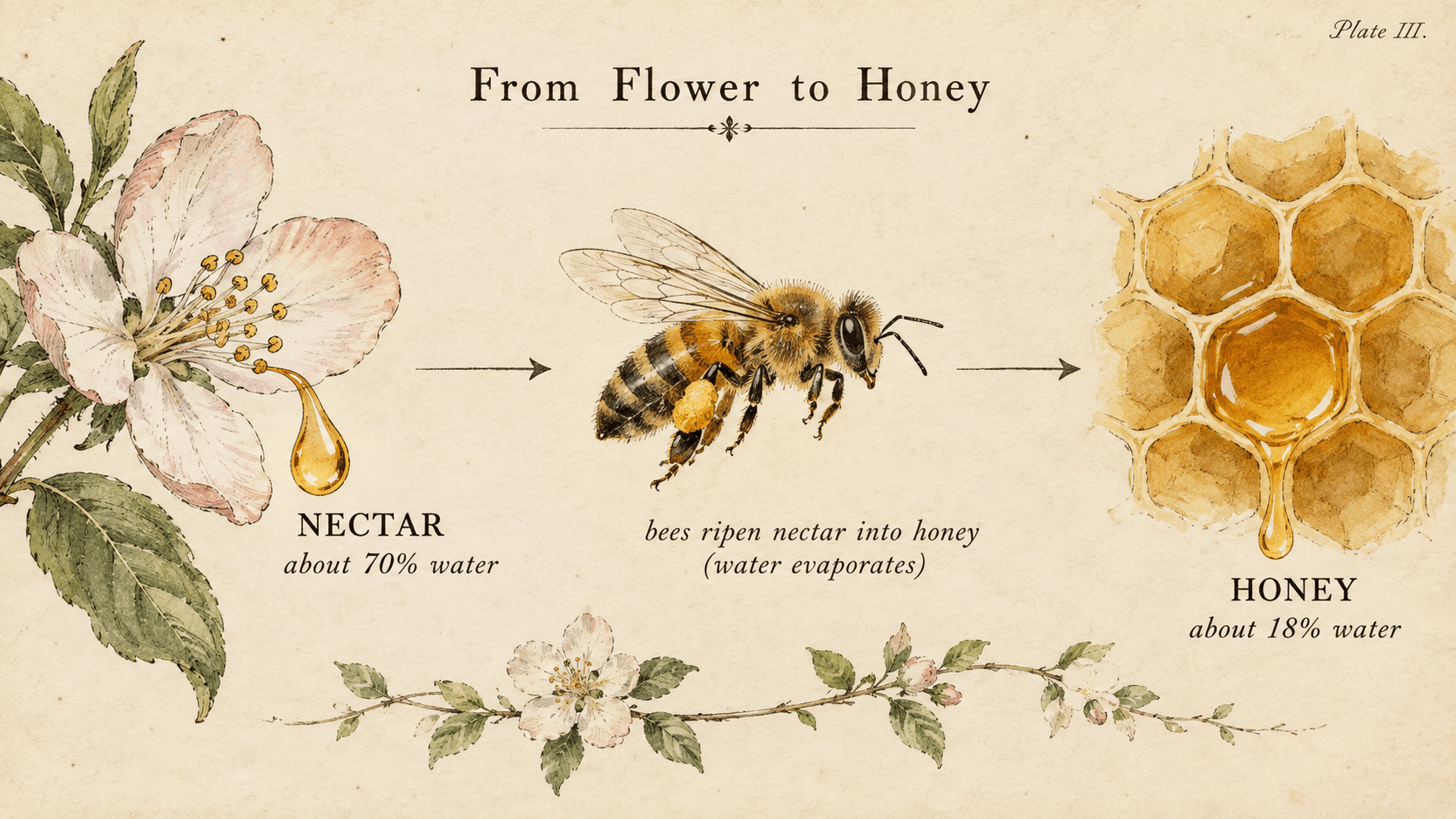
“The honey as it is collected in the flower and carried to the hive is not honey proper. The nectar of flowers is a thin sweet juice which may be properly called crude honey. This is collected by bees into the hives, and there converted into honey proper.”
Chimborazo Hospital reached for honey because the Union blockade had cut off almost everything else, and honey was one of the few remedies the South still had on hand in quantity. Nobody on staff could have explained why it worked. That answer came later: an enzyme called glucose oxidase converts the sugar in honey into hydrogen peroxide, and that peroxide is most of what makes honey antibacterial and resistant to spoiling. The mechanism wasn't identified until 1963. The medicine was doing its job a full century before anyone could say what the job was. Casey's chapter follows that same gap into a stranger place: a 1964 federal case where marshals seized a distributor's honey along with a book that recommended it, on the theory that shelving the two together turned the book into illegal drug labeling. A court had to step in and rule that reading about honey wasn't a crime before the case could be settled. None of that legal argument changed the chemistry sitting in the jar the whole time. That's the connection to Exodus 3:17, God's promise of a land flowing with milk and honey. The promise never depended on Israel, or a courtroom, or a lab, understanding or approving of how the provision worked. It only depended on the provision being real, which it was long before anyone got around to proving it.
Bee Science
- Water content change, nectar to honey
- evaporates from roughly 70% water down to about 18% water, creating a stable, non-fermenting product
- Distinct substances identified in honey
- more than 180, including sugars, proteins, vitamins, minerals, enzymes, and the flavonoids/phenolic acids behind darker honeys' antioxidant content
- Antibacterial mechanism
- the enzyme glucose oxidase converts glucose into gluconic acid and hydrogen peroxide; the peroxide is most of what makes honey antibacterial and resistant to spoilage
- Honey fraud
- honey is the third most faked food in the world, behind olive oil and milk, commonly cut with corn/rice syrup or ultrafiltered to strip out identifying pollen
Cited research (6)
- da Silva, P.M. et al. (2016), Food Chemistry 196:309-323: Honey's 180+ identified compounds and its crystallization chemistry (the sucrose-derived glucose:fructose ratio decides how fast a honey crystallizes)
- White, J.W., Subers, M.H. & Schepartz, A.I. (1963), Biochim. Biophys. Acta 73: Identified hydrogen peroxide, generated via glucose oxidase, as honey's primary antibacterial agent
- Molan, P.C. (2001), Am. J. Clin. Dermatol. 2: Mechanism of honey in wound/burn treatment: osmotic moisture draw plus hydrogen peroxide
- Nelson, Sturtevant & Lineburg, USDA Bulletin 1222 (1924): During a nectar dearth, older larvae ran 6-8% underweight; feeding thin sugar syrup restored growth, up to 8.1% heavier by day six than larvae raised with no flow at all
- Olmsted, Larry, Real Food/Fake Food (2016): Honey ranked third most faked food worldwide, behind olive oil and milk
- Gentry, C., Small Scale Beekeeping, Peace Corps (1982): Warns that sugar water is 'the most insidious honey contaminant'; recommends comb honey as proof against adulteration since bees seal it themselves
Scripture
Anchor: Romans 1:20
Also touches
Civil War Recordcivil war
Chimborazo Hospital's blockade-era honey medicine, and the 1964 court fight over saying so
- Confederate Surgeon General Samuel P. Moore authorized Chimborazo Hospital in 1861; Dr. James B. McCaw built it into the largest military hospital in North America to that point, treating roughly 76,000-78,000 patients with an unusually low mortality rate (about 9-11%)
- The Union blockade cut off normal medical and food supplies, so the hospital became largely self-sufficient (gardens, bakery, brewery, icehouse, cattle and up to 500 goats); no documented on-site apiary or beehives exist in the historical record, despite that being an earlier draft's claim
- Moore commissioned physician Francis Peyre Porcher to survey Southern plant-based substitute medicines under blockade, published in 1863 as Resources of the Southern Fields and Forests; an Emory University review (2019) validated several of Porcher's plant antiseptics
- In 1964, U.S. marshals seized a New York distributor's stock of Sterling Vinegar and Honey along with copies of Dr. D.C. Jarvis's Folk Medicine, after a district court ruled that shelving the book near the honey turned the book itself into illegal drug 'labeling'
- The Second Circuit reversed on November 18, 1964 (Chief Judge Lumbard), rejecting the government's 'proximity' theory that a book becomes a drug label merely by being sold near a product it describes: United States v. Balanced Foods, Inc., 338 F.2d 157 (2d Cir. 1964)
Primary sources (4)
- notes/chapters/citations.md, Ch.13 section (Chimborazo verdict table)
- Francis Peyre Porcher, Resources of the Southern Fields and Forests (1863)
- United States v. Balanced Foods, Inc., 338 F.2d 157 (2d Cir. 1964), CourtListener/Justia opinion text
- Fred Malone, Bees Don't Get Arthritis (1979), pp. ~175-176
verified
From the Book
Honey stands as the crown jewel of the hive, the sweet reward after all the colony's labor. What begins as watery nectar turns into liquid gold through a process only bees can perform. I'll never forget the first taste of honey from my own hive, that moment of lifting a dripping frame into the sunlight, watching amber sweetness catch the rays while the scent rose like a prayer. The flavor struck me speechless, a complex melody of flowers and sunshine unlike anything from a store shelf. This wasn't mere sugar water with flavoring, but nectar transformed through patient, purposeful labor into something entirely new, a testament to God's creative genius expressed through these tiny creatures. The wonder of it never leaves me, even after years of beekeeping. The journey from nectar to honey flows through a remarkable process of community cooperation. Foragers gather nectar from flowers miles away, storing it in their honey stomachs where enzymes begin breaking down complex sugars into simpler forms. Upon returning to the hive, house bees receive this partially processed nectar, passing it mouth to mouth between workers, each adding enzymes that continue the transformation. These patient workers then deposit tiny droplets into honeycomb cells, fanning their wings to create air currents that evaporate moisture until the water content drops from approximately 70% to 18%, creating stable, non-fermenting honey. When properly cured, workers cap each cell with a thin layer of wax, sealing this liquid treasure for future use, storing dozens of pounds to sustain the colony through winter scarcity. The finished product represents not just food but a community's foresight and labor, a sweet substance with antimicrobial properties that can remain unspoiled for centuries.
Get the full book →