© 2026 Casey Spitnale
Chapter 12
A Sense of the Meeting
How a Swarm Decides Together
“Some decisions do need to be made quickly, even if the choice is imperfect.”
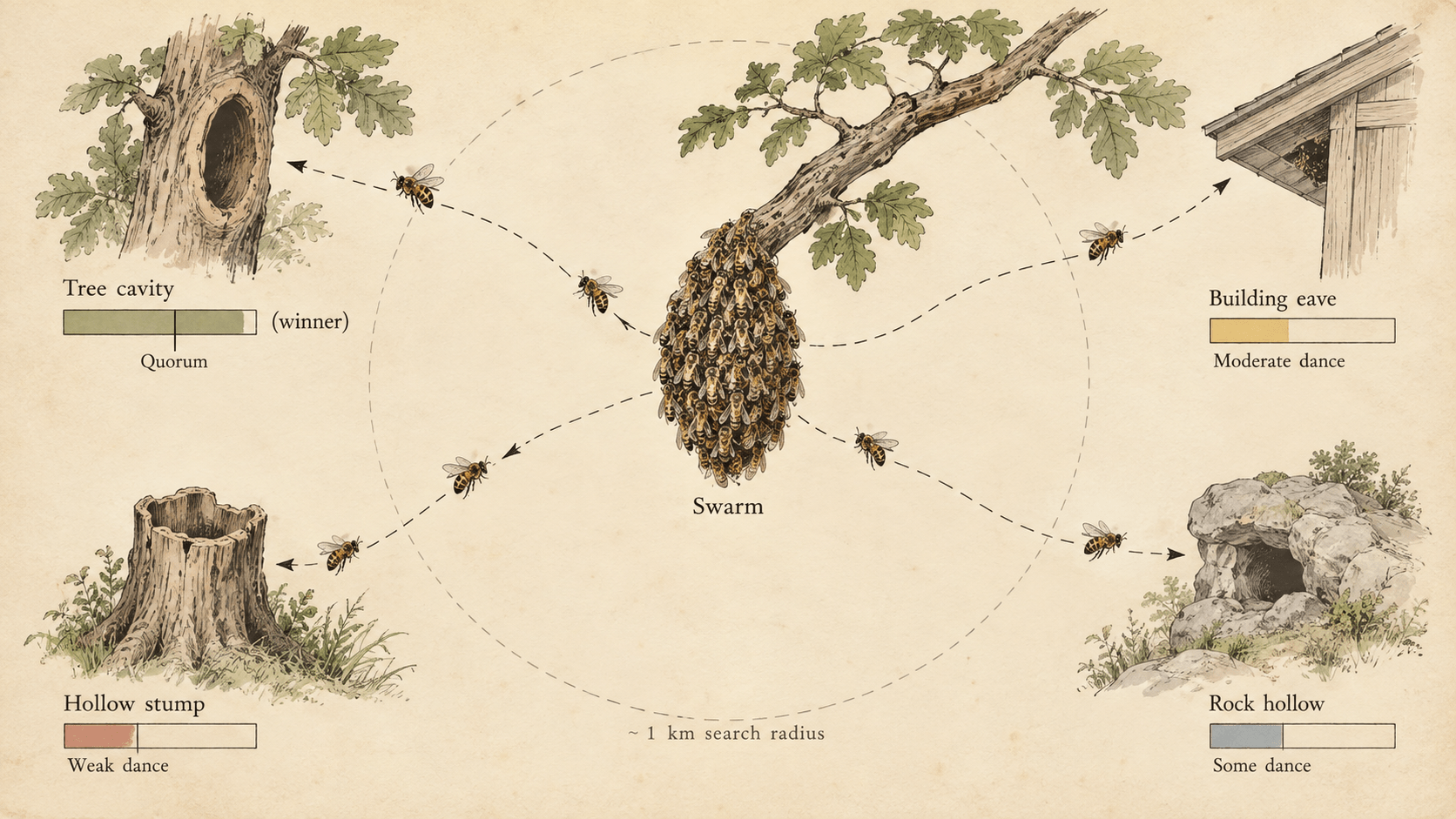
What ties the swarm to Gettysburg and to Acts 15 isn't the setting, a tree branch versus a farmhouse versus a council chamber. It's who gets to speak. A scout bee won't dance for a site she hasn't personally checked, Meade's generals answered from what they'd actually seen on that day's field, and the apostles at Jerusalem let Peter, Paul, and Barnabas testify to what they'd witnessed firsthand among the Gentiles before anyone rendered a judgment. None of the three systems ran on rumor. None of them ran on a vote count either. A swarm doesn't need every scout to agree, just enough of them standing at the same site at once, in person, for the decision to tip. Meade didn't poll his commanders and average the results; he read the room and committed to what it had told him. James didn't overrule the council with his own authority; he pronounced what the assembly had already reached together. Casey's point is that real consensus looks less like winning an argument and more like enough honest witnesses ending up in the same place. Casey has caught swarms himself, an easy one off a bush and a harder one over a sidewalk full of people at his son's ballgame, and neither one asked his opinion before the bees had already decided. The lesson he takes from all three stories is the same: quick and right aren't opposites, as long as the people deciding actually went and looked first.
Bee Science
- Scout search radius
- several hundred of the oldest, most experienced bees in the cluster search an area of up to seventy square kilometers, roughly twenty-seven square miles, for a new home
- Dissent decay
- every dancer's advocacy decays on a fixed internal schedule, roughly fifteen fewer circuits per trip regardless of site quality; something like ninety-six percent of scouts abandon a losing site before ever switching to dance for the winner
- Quorum threshold
- once twenty to thirty scouts are standing together at one site at the same time — physically present, not just dancing back at the cluster — that threshold triggers piping and departure
- Quorum-manipulation experiment
- deliberately spreading scout attention across several identical boxes at one site, without touching the dance itself, delayed a swarm's departure from under three hours to nearly seven
Cited research (5)
- Seeley, T.D. (2010), Honeybee Democracy, Princeton University Press: Synthesizes decades of swarm house-hunting research — scout search radius, dance-vigor calibration, dissent decay, quorum sensing — and opens its consensus chapter with the Quakers' "sense of the Meeting" tradition, including the unsoftened anecdote of an elderly Friend who withheld consent to relocate a meetinghouse for four years
- Lindauer, M. (1950s field studies, as reported in Seeley 2010): Tracked 17 swarms; one, the "Balcony swarm," deadlocked between two sites and launched before quorum was reached, splitting in midair and losing the queen — the only total failure among the 17
- Britton, N.F., Franks, N.R., Pratt, S.C., & Seeley, T.D. (2002), "Deciding on a new home: how do honeybees agree?", Proceedings of the Royal Society of London B, 269:1383-1388: The mathematical model introduced in ch.11, whose authors needed the word "evangelist" for a dancing scout still winning support for her site — describing the same swarm decision this chapter follows in full
- von Frisch, K., Nobel Lecture (1973): Credits Martin Lindauer with proving him wrong about the source of the dance's directional errors (the Earth's magnetic field, confirmed by screening and bending it experimentally), and describes a wild swarm building an orderly set of parallel combs overnight with "no superintendent"
- Phillips, E.F. (1914) and Butler, C.G. (1954): A generation apart, both admit swarming's ultimate trigger is still not understood: "it might as well be confessed that we know but very little about this remarkable instinct of the bee" (Phillips); Butler, forty years later, says the same
Scripture
Anchor: Romans 1:20
Also touches
Civil War Recordcivil war
Meade's council of war at Gettysburg (July 2, 1863), paired with Bryan, Ohio's 1909 cavalry bivouac
- On the night of July 2, 1863, after a costly second day at Gettysburg, Gen. George Meade gathered his corps commanders (Hancock, Gibbon, Slocum, Williams, Newton, Howard, Sedgwick, Sykes, Birney) at the Leister farmhouse; his chief of staff Daniel Butterfield recorded three questions and each general's answer, and the minutes survive
- The council reached a shared sense of the room rather than a binding vote: Meade committed to stay and fight, and privately told Gibbon, "If Lee attacks tomorrow, it will be in your front"; Pickett's Charge struck Gibbon's line the next afternoon exactly as Meade anticipated
- On Friday, July 16, 1909, about two hundred troopers of the 15th U.S. Cavalry (Troops I, L, and M), rerouted from Montpelier by bad roads, camped overnight in Bryan, Ohio on their march from a Toledo military tournament back to Fort Sheridan, Illinois — verified against the Bryan weekly newspaper's contemporary account (July 22, 1909) and two surviving real-photo postcards dated by the Williams County Public Library's Local History Center
- Bryan had sent its own company to the Civil War decades earlier: Company C of the 100th Ohio, which the house-bee chapter follows to Limestone Station
Primary sources (5)
- Butterfield's minutes of Meade's July 2, 1863 council of war (Official Records, Series I, Volume 27, Part 1)
- Gibbon, Personal Recollections of the Civil War
- notes/research/bee-facts-and-meade-council-2026-09-13.md
- Bryan weekly newspaper, July 22, 1909 (transcribed in notes/research/bryan-ohio-15th-cavalry-1909.md)
- Two real-photo postcards, a Bryan private collection, dated via the Williams County Public Library Local History Center
verified
From the Book
When a colony outgrows its box, roughly two-thirds of it leaves with the old queen and settles into a tight, quiet cluster on the nearest branch, sometimes no more than thirty feet from the hive it just left. From the outside, it looks like ten thousand bees with nowhere to go. They don't have anywhere to go yet, and for the next few days, some of the most sophisticated decision-making in the natural world happens inside that basketball-sized clump hanging in open air. Seeley's word for that cluster is a bivouac, the army's word for a camp pitched for one night on the way to somewhere else, and I know exactly what he means, because the town I live in got one once. On Friday, July 16, 1909, around one in the afternoon, three troops of the 15th U.S. Cavalry rode into Bryan, Ohio, about two hundred men on their way home to Fort Sheridan, outside Chicago, from a military tournament in Toledo. Bryan wasn't on the route. Montpelier, north of town, had been expecting them, had advertised the visit and lined up feed for the horses, but the roads up that way were bad, so the column swung south to the good east-west road and came through Bryan instead. Word reached town that morning. By the time the horses came in, there were flags the length of the streets.
Get the full book →