© 2026 Casey Spitnale
Chapter 11
The Waggle Dance
Evangelizing the Good News
“Bees have a language.”
The word "evangelist" isn't a stretch Casey applies to the dance from the outside. It's the actual technical term researchers reached for when they modeled how a scout wins support for a new home, and that detail is the hinge of the whole chapter: a behavior nobody claims is intentional still takes the exact shape of a message meant to be followed, not just believed. That shape is what connects the dance to Harriet Tubman. Both the forager and Tubman gave precise, repeatable directions rather than a general assurance that something good existed somewhere else. A recruited bee can fly a route she's never seen because the dance told her the angle and the distance, the same way people moving north on the Underground Railroad needed an actual path, not just word that freedom was out there. Casey lines that up with John 14:6, Jesus naming himself the way rather than a vague destination. Casey stays careful about the comparison, the same way the scientists studying the dance stay careful about calling it a language. Nobody claims the bee means to preach. But something that precise, produced without intention, is exactly what Romans 1:20 says creation should look like: a pattern clear enough to point past itself, whether or not the thing making the pattern knows it's pointing.
Bee Science
- Waggle-run precision
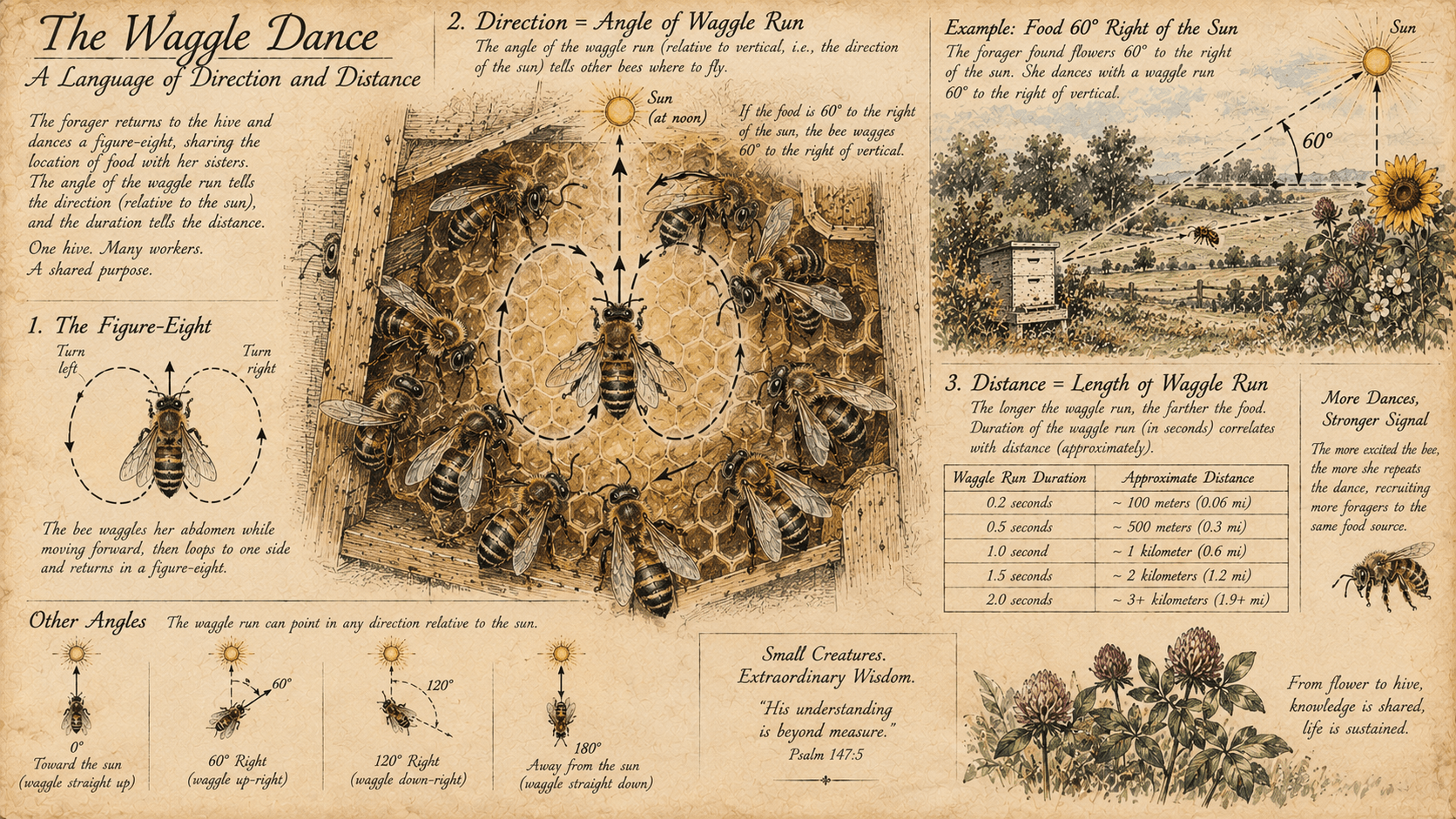
- the angle of the waggle run relative to vertical matches the angle between the sun and the food source, and dance duration corresponds to distance; recruits find sources within roughly 10-15 degrees of direction and about 10% of distance
- Internal clock
- bees carry a working clock accurate to about a day, first proven in 1929 by sealing trained bees away from all daylight; bees flown from Paris to New York in 1955 kept arriving at a feeder on their old Parisian schedule for days
- Radar-confirmed navigation
- recruited bees fly the actual course the dance describes rather than simply tailing an experienced forager
- Bee color vision
- bees see into the ultraviolet but sort color into far fewer distinct hues than the roughly 130-180 a human eye can tell apart, and need a light dimmed to about 70% (vs. humans' 90%) before they can tell it apart from another
Cited research (5)
- Britton, N.F., Franks, N.R., Pratt, S.C., & Seeley, T.D. (2002), "Deciding on a new home: how do honeybees agree?", Proceedings of the Royal Society of London B, 269:1383-1388: Models swarm nest-site consensus using the technical vocabulary "evangelist" for a dancing scout and "non-evangelical believer" for a supporter who has stopped dancing — the source of the book's central metaphor, independently confirmed rather than invented by the manuscript
- Seeley, T.D. (2010), Honeybee Democracy, Princeton University Press: Describes the dancer as "an evangelizing scout bee" who succeeds by "gaining converts" (ch.6, "Building a Consensus")
- von Frisch, K. (1967), The Dance Language and Orientation of Bees; shared the 1973 Nobel Prize in Physiology or Medicine (with Konrad Lorenz and Niko Tinbergen): Measured directional error of roughly 10-15 degrees and distance error of about 10% in waggle-dance recruitment; the Nobel was for the broader field of animal-behavior science, not awarded specifically for this one book
- Riley, J.R. et al. (2005), "The flight paths of honeybees recruited by the waggle dance," Nature 435:205-207: Radar-tracked recruited bees flying the course indicated by the dance, confirming the dance itself carries real navigational information
- Beling, I. (1929); Renner, M. (1955); Beier & Lindauer (1970): Established the forager's internal circadian clock and its role in correcting the dance for the sun's ongoing movement across the sky
Scripture
Anchor: Romans 1:20
Also touches
Civil War Recordcivil war
Harriet Tubman's Underground Railroad network and her Civil War service at the Combahee River Raid, June 1863
- Careful modern research puts Tubman's personal trips into slave territory at around thirteen journeys between 1850 and 1860, guiding roughly seventy enslaved people to freedom herself — a more modest, better-documented count than the legendary numbers often repeated about her
- Thomas Garrett, a Quaker who worked alongside her, wrote of her: "I never met with any person, of any color, who had more confidence in the voice of God, as spoken direct to her soul" — his real documented words, replacing an earlier invented quote about moss patterns and stone arrangements
- Frederick Douglass's real 1868 letter to Tubman: "The midnight sky and the silent stars have been the witnesses of your devotion to freedom and of your heroism... I have wrought in the day, you in the night"
- During the Civil War she served the Union Army as a scout and spy, helping map Confederate positions along South Carolina's Combahee River; that intelligence enabled Col. James Montgomery's raid in June 1863, freeing more than 700 enslaved people — the first major U.S. military operation planned and led in part by a woman
- The barred-owl-call/coded-song signaling tradition is genuine oral tradition, but pinning a specific song as a proven tactical signal, or citing William Still's biography for seasonal bird-call detail, does not hold up and is not used in the chapter
Primary sources (4)
- Kate Clifford Larson, Bound for the Promised Land (2004)
- Thomas Garrett's letters (as quoted in the chapter)
- Frederick Douglass's 1868 letter to Tubman
- notes/chapters/citations.md, "Ch 11 — Harriet Tubman"
verified
From the Book
Bees speak an ancient language of movement. After discovering abundant nectar or pollen sources, forager bees return to the hive not just with treasures in their baskets, but with news to share. One summer afternoon, while inspecting a frame heavy with workers, I witnessed a returning forager clear a small space on the comb and begin a mesmerizing performance. Her body vibrated with intensity as she traced a precise figure-eight pattern, other bees gathering close, their antennae touching her vibrating form to receive her message. This dance, performed in near darkness on a vertical surface, contains detailed directions to food sources that may lie miles from the hive. In that moment I understood I was watching one of nature's most sophisticated communication systems, good news passed along through movement and touch rather than words. The straight-line portion of her figure-eight, performed with rapid side-to-side vibrations of her body, indicates both distance and direction to the treasure she has found. The angle of this "waggle run" relative to vertical corresponds exactly to the angle between the sun and the food source, while the duration of her dance correlates precisely with distance, longer dances indicating more distant locations. Other bees follow closely, their sensitive antennae picking up minute vibrations and pheromones, their own bodies beginning to mirror her movements as they absorb the message. This information transfers with such accuracy that recruited foragers can fly the course her dance describes, often a mile or more away, arriving in the general vicinity of a flower they've never visited before closing the last stretch by scent and memory. What's remarkable is that this isn't just my own reading into the behavior. When scientists built a mathematical model of how a whole swarm of bees reaches agreement on a new home, using the same kind of math epidemiologists use to model how an idea spreads through a population, they needed a word for the dancing bee trying to win converts to her discovery.
Get the full book →