© 2026 Casey Spitnale
Chapter 10
The Forager Bee
Sharing the Beauty
“Call me what you will, a Daw, and say I am stuck over with other Peoples Feathers, with all my Heart; but it would be altogether as just to compare me to the Bee... for tho I pick up my Matters in a thousand Places, 'tis not to look gay my self, but to furnish you with Honey. I have rifled a thousand Flowers... to load your Hive.”
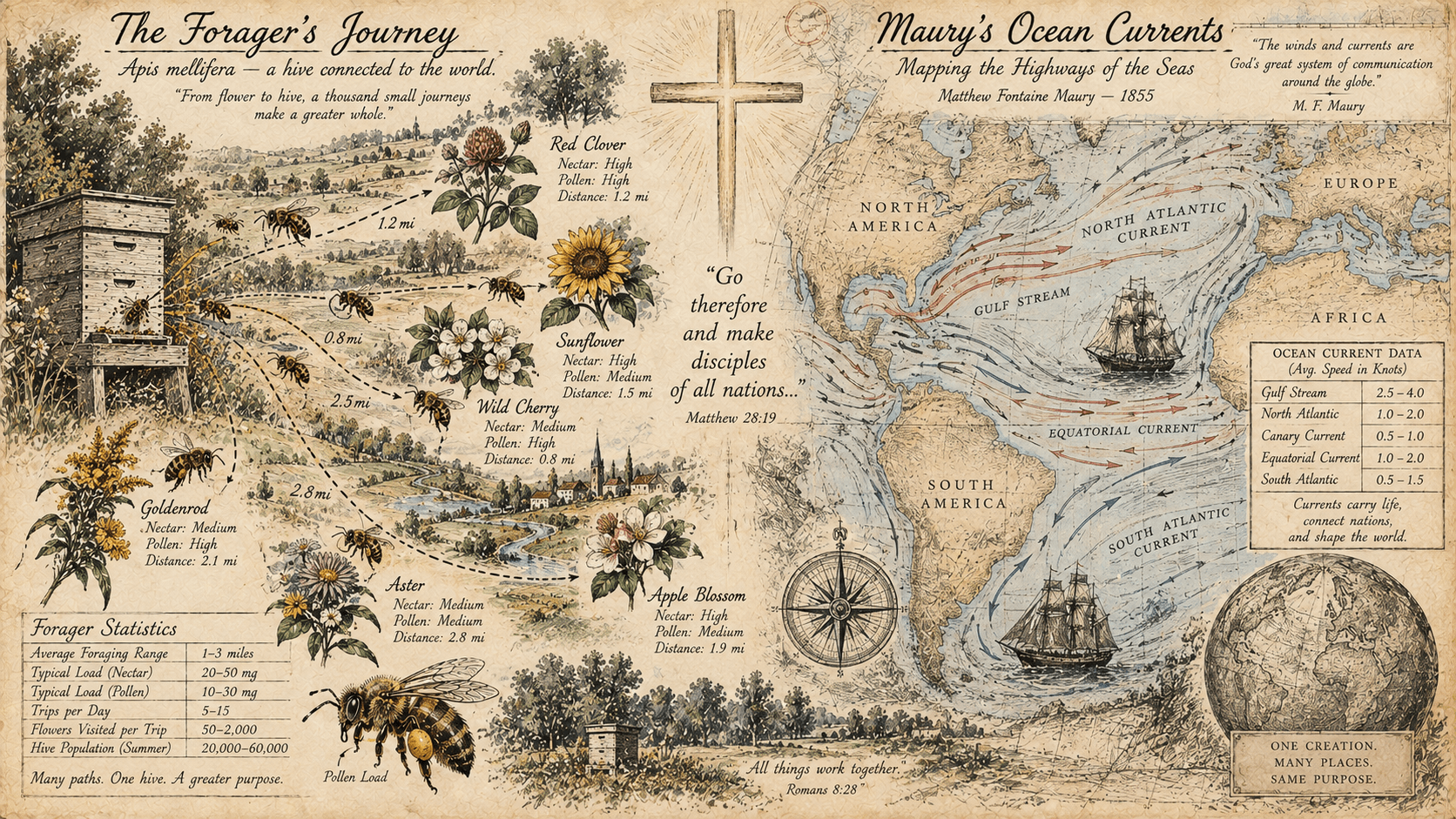
The chapter's throughline is less about flight and more about what a forager does with what she finds. She doesn't hoard nectar in her own stomach; she carries it home and hands it off, over and over, until her wings are too worn to fly another trip. Casey sets that instinct next to Matthew Fontaine Maury, who took what used to be private information, one captain's logbook of winds and currents at a time, and made it public property for every sailor who wanted it. Neither the bee nor the lieutenant discovered anything for their own sake. They discovered things to give them away. Casey's own version of this plays out season after season in an Ohio backyard: workers leaving empty and coming back loaded, tomatoes and buckwheat and zucchini turned into cargo the moment it's found. It's the same instinct behind Mark 16:15's call to go into all the world, not because the going is glamorous, but because whatever gets found is meant to move past the finder. There's a quieter half to that instinct too. A forager spends less of her short life in the air than she does waiting inside the hive between trips, and Casey reads that alongside Mark 6:31, Jesus pulling the disciples aside to rest after their own trip out. The traveling gets remembered. The waiting is where most of a working life, bee or human, actually happens.
Bee Science
- Lifetime foraging flight distance
- something like five hundred miles over a forager's brief career (corrected from a 25x-inflated "half the earth's circumference" claim in an earlier draft)
- Range and load per trip
- flies up to three miles from the hive, visits fifty to one hundred flowers per trip, and can carry up to half her own body weight in nectar and pollen combined
- Trip length swings with the nectar flow
- average trip length ran as short as 8.92 minutes on a strong April flow day and as long as 103.92 minutes on a July dearth day
- Non-return rate
- about 3.16% of exits never returned, which Lundie's own math converts to roughly one death per 31.65 trips — his own careful estimate, not a directly observed constant
Cited research (3)
- Seeley, T.D. (1995), The Wisdom of the Hive, Harvard University Press: Foragers weigh distance, nectar concentration, and flower density against the energy cost of a trip, and abandon a flower once its nectar grows too thin to be worth collecting
- Nixon, H.L. & Ribbands, C.R. (1952), tracer studies: Showed how quickly a single forager's discovery spreads through the colony, her nectar passed mouth to mouth until dozens of house bees know its source within the hour
- Lundie, A.E. (1925), The Flight Activities of the Honeybee, USDA Department Bulletin No. 1328: An automated electric-gate apparatus recorded roughly five million individual bee flights (April-July 1922); its headline finding, stated twice in the bulletin: "even in a strong honey flow the bees spend more time in the hive between the voyages than they do on the voyage itself"
Scripture
Anchor: Romans 1:20
Also touches
Civil War Recordantebellum
Matthew Fontaine Maury's ocean-current and wind charts, The Physical Geography of the Sea (1855)
- Lt. Matthew Fontaine Maury, working out of the U.S. Naval Observatory, gathered wind, current, and weather data from thousands of ships' logs and turned individual captains' private observations into one shared, standardized body of knowledge
- His book, The Physical Geography of the Sea (1855), often called the first oceanography textbook, revealed routes that cut the voyage from New York to San Francisco from roughly 180 days down to around 133
- A paper read before the British Association estimated his charts saved international shipping on the order of ten million dollars a year — the figure is real, though the manuscript's earlier "London Times, April 12, 1858" citation for it was not and has been replaced
- Maury's own documented line, quoted in the chapter: "Every physical fact is a word of testimony"
- He resigned his U.S. Navy commission in 1861 and served the Confederacy (mines, and later an agent in England) — a complicated legacy historians still argue over
Primary sources (3)
- Matthew Fontaine Maury, The Physical Geography of the Sea (1855)
- A paper read before the British Association (cited for the $10M/year shipping-savings estimate)
- notes/chapters/citations.md, "Ch 10 — Matthew Fontaine Maury"
verified
From the Book
Around day 21 of their short lives, worker bees graduate to their final and most spectacular role: foraging. These seasoned travelers venture beyond the safety of the hive to discover distant treasures, returning with news of abundance. I've watched this transition play out for years in my own garden, standing over rows of tomatoes, buckwheat, zucchini, and whatever else does well in an Ohio backyard. Workers exit the hive with purpose, their bodies lean and ready for flight, and go straight to work on whatever's blooming that week. They depart empty and return laden with golden pollen packed tight on their legs, nectar filling their honey stomachs, their very bodies transformed by the beauty they had found. The forager's life represents the pinnacle of bee service, a calling that continues until her wings literally wear out. Flying up to three miles from the hive, she visits fifty to one hundred flowers on a single trip, gathering nectar through her specialized tongue into her honey stomach, collecting pollen in the bristled baskets on her hind legs. She can carry an astonishing load, sometimes half her body weight in nectar and pollen combined, maintaining perfect flight balance despite this heavy burden. When her honey stomach fills or her pollen baskets overflow, she returns directly to the hive with her precious cargo, unloading nectar to house bees and storing pollen by brushing it into cells with her legs. A successful forager might make ten to fifteen trips daily in favorable weather, flying something like five hundred miles over her brief foraging career. By the end, her wings look like a fighter plane's after a dogfight, worn thin and glassy, notched with tiny holes, edges clipped away one flight at a time until there's barely enough left to fly on. She dies still searching for one more bloom to serve her sisters, usually out in the field rather than at home.
Get the full book →