© 2026 Casey Spitnale
Chapter 9
The Guard Bee
Defending the Faith
“Cowardice is not an element of their nature; they fear no foe, and shrink from no danger.”
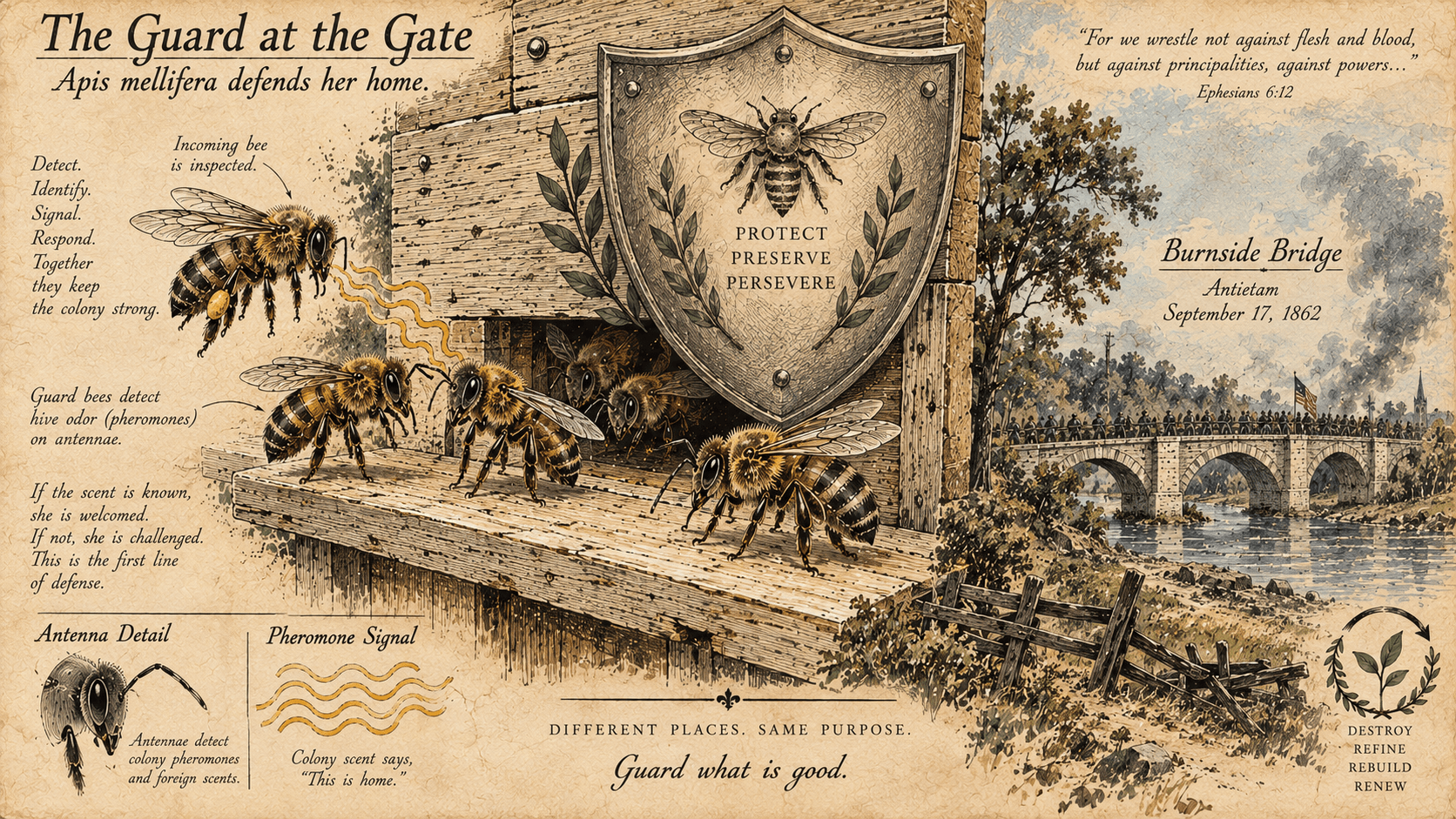
The chapter's throughline is that defense, done right, is discernment before it's force. A guard bee doesn't meet every visitor with the same fury: she reads scent and behavior first, and escalates only when the threat is real. That precision, not blind aggression, is what Casey holds up against Burnside Bridge, where a few hundred Georgia riflemen held a vastly larger Union corps for three hours, not because they meant to win the whole battle, but because the position was worth the cost of holding as long as they could. Ephesians 6:11 asks believers to "take your stand," not to charge. Casey reads that as the same posture: guarding what matters isn't about picking fights, it's about knowing what's worth defending and staying at the post once you've decided. The guard bee who lingers long enough on a strange comb to take on its scent doesn't stay a guest. She becomes part of what she's defending, which is Casey's read on Ephesians 2:19's promise that former strangers become fellow citizens with a post of their own. And guard duty doesn't clock out. Long after foragers have called it a night, guards are still at the entrance, antennae up. Casey ties that to Psalm 121:4's watcher who neither slumbers nor sleeps: the kind of care that doesn't take breaks isn't incidental. It's the whole point.
Bee Science
- Onset of guard duty
- around day 17 of a worker's life, a distinct age-based task with its own window and a lot of individual variation in how long any one bee sticks with it
- Adoption window
- an intruder that lingers roughly two hours on the comb picks up the hive's own wax-and-food scent and stops being challenged; one such adopted intruder was seen guarding its new hive's entrance within 24 hours against members of its own parent colony
- Alarm pheromone
- isopentyl (isoamyl) acetate identified as the primary component of the sting pheromone that recruits nearby workers to defense
- Trained bee detectors
- bees conditioned via the proboscis-extension reflex (sugar water paired with a scent) were built into a three-bee explosives/narcotics detector, and a University of Montana project used tagged foragers to help locate buried land mines
Cited research (3)
- Moore, A.J., Breed, M.D., & Moore, K.M. (1987), "The Guard Honey Bee," Animal Behaviour 35:1159-1167: Established guarding as its own specialized task with a distinct age window and a lot of individual variation in duration — the well-documented mechanics (cuticular-hydrocarbon sampling, the raised-wing/open-mandible threat posture, graded response) are attributed to "work since then," not put in this one paper's mouth
- Boch, R., Shearer, D.A., & Stone, B.C. (1962), "Identification of Isoamyl Acetate as an Active Component in the Sting Pheromone of the Honey Bee," Nature 195:1018-1020: The paper that actually identified isopentyl (isoamyl) acetate as the alarm pheromone; replaced an unverifiable "Journal of Chemical Ecology, Volume 24, 1998" citation in the manuscript, 2026-09-09
- Butler, C.G. (1954), The World of the Honeybee: Colony-odour chapter (printed pp.144-151): guards appear mainly in late-summer dearth, alternate guard duty with foraging, and reject or admit intruders based on flight behavior and scent rather than smell alone
Scripture
Anchor: Romans 1:20
Also touches
Civil War Recordcivil war
The stand at Burnside Bridge, Antietam, September 17, 1862
- A detachment of the 2nd and 20th Georgia regiments (likely fewer than 400-550 rifles between them), under the on-scene command of Col. Henry L. Benning within Brig. Gen. Robert Toombs's brigade, held Burnside Bridge for roughly three hours against Gen. Ambrose Burnside's Ninth Corps, numbering roughly 12,500 (Official Records, Series I, Volume 19, Part 1)
- Lt. Col. William R. Holmes, commanding the 2nd Georgia, was killed defending the bridge; his after-action report was filed in his place by Capt. Abner Lewis. Col. John B. Cumming led the 20th Georgia beside them
- Pvt. Theodore T. Fogle of the 2nd Georgia left a letter, preserved in Emory University's manuscript collections, describing the retreat: the men fell back "only because our ammunition was exhausted"
- The Georgians withdrew in order, not by annihilation, once Union troops crossed downstream at Snavely's Ford and turned their flank; the two regiments lost something like a third of their engaged numbers between them — real and costly, but far short of the destruction an earlier, fabricated draft of this chapter had claimed
- Gen. James Longstreet's memoir credits the delay with giving Confederate reinforcements under Gen. A.P. Hill time to march the seventeen miles from Harper's Ferry and strike the Union flank as it began to break through
Primary sources (4)
- Official Records of the Union and Confederate Armies, Series I, Volume 19, Part 1 (Toombs's and Benning's reports)
- Stephen W. Sears, Landscape Turned Red: The Battle of Antietam (Ticknor & Fields, 1983)
- Pvt. Theodore T. Fogle's letter, Emory University manuscript collections
- Gen. James Longstreet, From Manassas to Appomattox (1896)
verified
From the Book
Around day 17 of their lives, certain worker bees take up a holy calling as sentinels, positioning themselves at the entrance of the hive with unwavering vigilance. Not just anyone gets past them. These guard bees form the colony's first line of defense, scrutinizing every visitor with their antennae, ready to sound the alarm if danger approaches. I discovered their dedication the hard way during my early days of beekeeping when, rushing through an inspection without adequate smoke, I disturbed their careful watch. The result was swift and painful, a lesson about respecting boundaries etched into my skin through a well-placed sting. Now I understand that God instills protective instincts throughout His creation, a reflection of His watchful care over what He values. For those few days, their bodies stay oriented toward approaching visitors, antennae extended to sample the air. With remarkable precision, they can distinguish between returning foragers who belong to their colony and potential intruders through subtle chemical signatures. When they detect a threat, they release alarm pheromones that rally their sisters to defense, transforming individual vigilance into collective protection. These sentinels will challenge wasps, robber bees from other colonies, and larger predators without hesitation, willing to sacrifice their lives to preserve the community they serve. Their selfless defense creates a barrier between the colony's precious resources and the many threats that would consume them, a living shield that protects the queen, the developing brood, and the hard-earned honey stores.
Get the full book →