© 2026 Casey Spitnale
Chapter 8
The Wax-Making Bee
Building the Foundation
“Wax is not gathered like pollen or propolis. The bees have to manufacture it at very great cost, both to themselves and their owners. As milk is manufactured in the body of the cow, so wax is manufactured in the bodies of bees.”
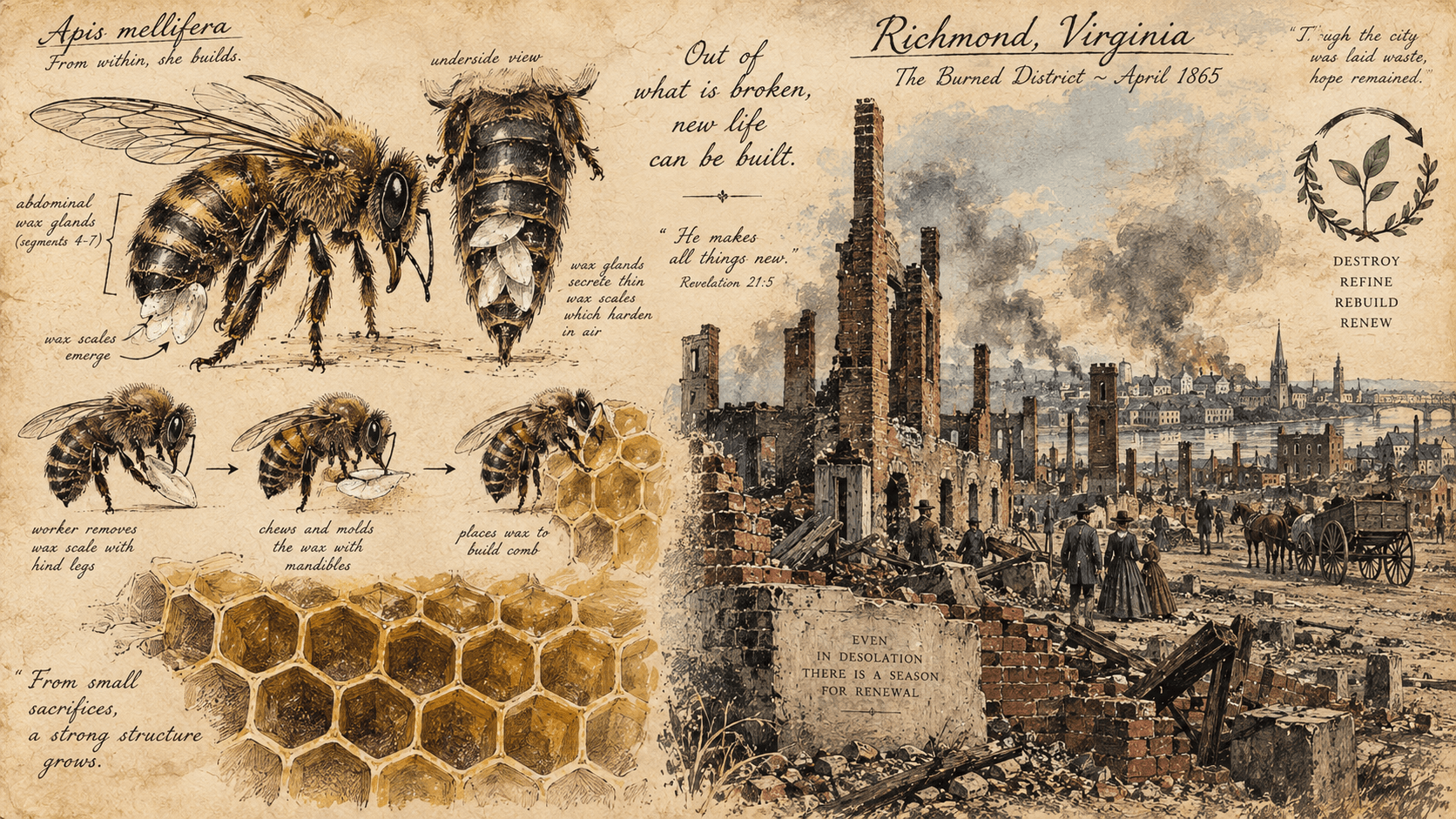
Chapter 8 sits with three different kinds of rebuilding. Casey crushed a section of empty comb with one careless graze of his hive tool and watched something that took hundreds of hours to build collapse like tissue paper. His mentor Marc's answer was simple: leave it, the bees will clean it up and start again. They did, using the same wax-gland machinery, roughly six to eight pounds of honey converted through their own bodies for every pound of wax rebuilt. Richmond did the slow, human version of the same thing. The retreating Confederate army's own fire burned nine-tenths of the city's business district in April 1865, and the rebuild that followed took years, not a triumphant overnight recovery. James Hanger did the individual version: eighteen years old and two days into his enlistment when he lost a leg at Philippi, he spent three months building a better prosthetic than the one he'd been given, then spent the rest of his life building them for other men. None of these three skip a step. Acts 3:19 puts refreshing after repenting, not instead of it, and Isaiah 61:4 promises rebuilt ruins, not buildings that were never damaged. Casey's point is that the order never changes, whether it's a colony, a city, or a person. What's broken has to be cleared before the building starts, and nothing about the outcome is obvious going in. The comb Casey ruined came back anyway, one hexagon at a time.
Bee Science
- Wax-gland activation window
- worker bees develop wax-secreting glands on their abdomens from days 10 to 17 of their lives, producing thin white flakes they scrape off with their legs and mold into hexagonal cells
- Wax economics
- it takes roughly six to eight pounds of honey, consumed and converted through a bee's own body, to produce one pound of wax; once built into comb, that pound of wax can hold up to twenty times its own weight in honey
- Wax-working cluster temperature
- close to 92°F (commonly cited apiculture figures put wax-secretion cluster temperature in the mid-90s°F; the chapter's number is a defensible simplification, not an error)
- Hexagon shape from the first stroke
- pressed cylinders will settle into hexagons on their own by physics alone, but bees don't build cylinders and wait — they make the cells hexagonal from the first stroke
Cited research (3)
- H.R. Hepburn, Honeybees and Wax (Springer, 1986): Standard reference on the day-10-to-17 wax-gland activation window and the honey-to-wax conversion; cited in the chapter as the chemistry behind what Casey reads as design
- E.F. Phillips, The Habits of the Honeybee (A.I. Root, 1914): Bees build comb cells hexagonal from the outset rather than starting with cylinders that settle into the shape under physics alone
- Lauren Marra, Colony Collapse Disorder in North American Honey Bees (Fordham University thesis, 2014): Quoted verbatim on why skep-keeping killed the strongest hives first: "This meant that the strongest hives were often killed since their honey yield was greatest"
Scripture
Anchor: Romans 1:20
Also touches
Civil War Recordcivil war
Richmond's April 1865 evacuation fire, and James Hanger's Civil War amputation and prosthetics career
- As Confederate forces evacuated Richmond on April 3, 1865, officers set fire to the city's tobacco warehouses on Lt. Gen. Richard S. Ewell's orders, meaning to deny the material to the advancing Union army; the fire got away from them and burned nine-tenths of the business district (roughly 35 blocks) before Union troops, who occupied the city that same morning, got it under control that afternoon
- Richmond's rebuild was slow and uncertain, not a fast, triumphant story: the fire had destroyed most insurance records, capital was scarce, and it wasn't yet clear whether Confederate-owned property would stay in its owners' hands; reconstruction took years before the city found its footing again in iron, flour, and tobacco
- James Hanger was eighteen years old, two days into his Confederate enlistment, when a cannonball took his leg at Philippi, Virginia on June 3, 1861 — the first amputation of the entire war
- Hanger built himself a hinged wood-and-metal prosthetic leg within about three months, patented the design, and founded the company (now Hanger, Inc.) that still makes prosthetic limbs today
Primary sources (2)
- Encyclopedia Virginia, "Burned District in Richmond"; American Battlefield Trust, "Richmond in Flames and Rubble"; Emerging Civil War, "The Fall of Richmond, April 3, 1865"
- American Battlefield Trust; National Museum of Civil War Medicine; Hanger, Inc. corporate history page; Wikipedia (James Hanger, cross-checked via WebSearch)
verified
From the Book
I learned what a hive really is the hard way, the first time I accidentally crushed a section of empty honeycomb with the lightest graze of my hive tool. The delicate structure collapsed instantly, cells that had taken hundreds of hours to build crumbling like tissue paper in my clumsy hands. I stood there stunned, holding fragments of something that's paper-thin when it's empty and able to hold pounds of honey once the bees fill it. Most people never get to feel that contrast for themselves, since nobody hands you empty comb outside of a hive inspection. That moment taught me right away that bees build their home from their very bodies. From days 10 to 17 of their brief lives, worker bees transform into living factories of creation, developing specialized glands on their abdomens that produce tiny white wax flakes. I've watched them during hive inspections, small translucent flakes clinging to their undersides, which they scrape off with their legs and mold with their jaws into perfect hexagonal cells. Though I've never witnessed the actual building process start to finish, the evidence speaks clearly: what starts as their own bodily substance becomes architectural marvels designed to cradle eggs, store pollen, and preserve honey. This sacred work requires precise warmth, close to 92 degrees Fahrenheit, so they cluster together, their wings fanning to maintain the perfect temperature while transforming their bodies into the foundation of their home. The economics of it alone are staggering: it takes roughly six to eight pounds of honey, consumed and converted through their own bodies, to produce just one pound of wax, and once that wax is built into comb, it can hold something like twenty times its own weight in honey. When I consider that trade, I'm overwhelmed not just by the poetry of their work but by the quantifiable devotion embedded in every hexagon.
Get the full book →