© 2026 Casey Spitnale
Chapter 7
Surviving the Sting
Lessons from Bee Attacks
“Those bees which do not follow the example of the king quickly repent of the indiscretion, because they die after giving a prick with their sting. Let the Christians heed, who have received the command to render to no man evil for evil, but to overcome evil with good. Imitate the character of the bee.”
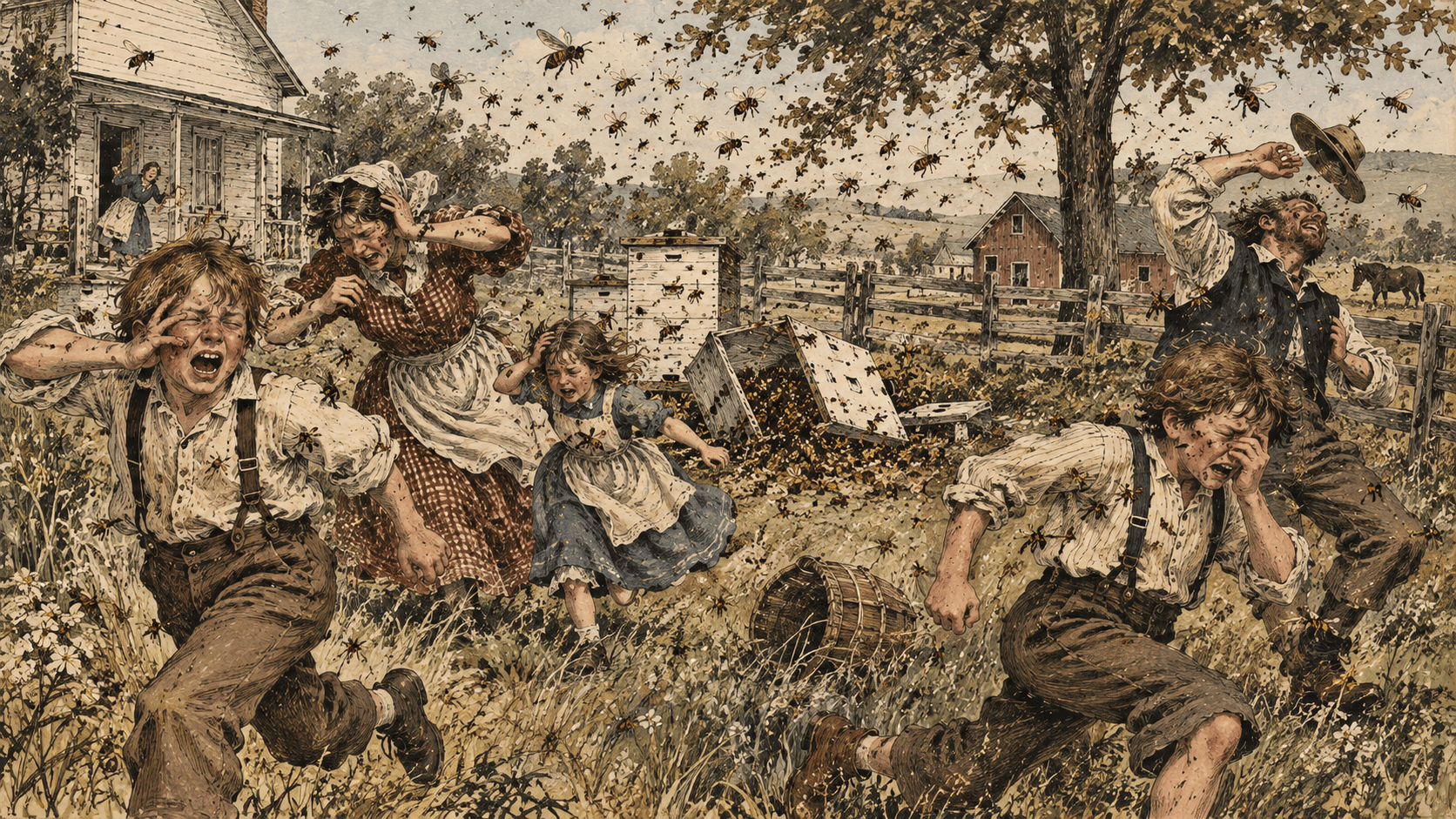
Chapter 7 holds two moments of the same instinct, twenty feet apart and a hundred years apart. When Casey's sister Stephanie was swarmed pulling kittens from a bush, what saved her wasn't fighting the bees off one at a time. It was running for the pond, because bees don't swim and let go the instant they're submerged. At Antietam on September 17, 1862, officers facing the same math made the same call: don't fight William Roulette's disturbed bees sting by sting, order the regiment to double-quick past the hives instead. Both moments turn on the same fact. A swarm can't be beaten bee by bee. Somebody has to find the one move that changes the whole fight. The chapter ties that to how the sting itself works. A worker bee's stinger is barbed, built to tear free and keep signaling other defenders after she's gone. It costs her everything, once. Casey reads Hebrews 12:11's discipline, the kind that trains rather than just hurts, through that lens, and lands on Psalm 23:4 for the rest of it: the valley doesn't disappear, but what a person walks through is the shadow, not the sting itself. That distinction is the point of the chapter. The fear in the moment, whether it's a bush full of bees or anything else that comes at a person all at once, is real. The response was never supposed to be heroics. It was supposed to be knowing where the water is.
Bee Science
- Stinger mechanics
- a worker's stinger is barbed and anchors in skin, tearing free of her body; the venom sac left behind keeps pumping and signaling after she's gone, calling in more defenders to the same spot
- Guard-bee kin recognition
- guard bees stationed at the hive entrance sample every scent that passes and can tell a sister from a stranger by chemistry alone
- Bees and water
- bees don't swim; once submerged, a bee goes from attacker to drowning insect and lets go
Cited research (3)
- Michael D. Breed, Ernesto Guzmán-Novoa & Greg J. Hunt, "Defensive Behavior of Honey Bees: Organization, Genetics, and Comparisons with Other Bees," Annual Review of Entomology 49 (2004): Guard bees recognize nestmates by cuticular hydrocarbon scent and reject non-nestmates by biting or stinging
- E.F. Phillips, The Habits of the Honeybee (A.I. Root, 1914): Opens with Louis Agassiz's line 'Study nature, not books' and argues direct observation of bees is worth more than time spent over bee-books — the source for the chapter's 'I'd read the pond' theme
- Émile Warré, Beekeeping for All (1948): Thirty years testing hive designs across 350 hives, worked bare-handed; 'when a beekeeper is stung by his bees he should always ask what mistake he has made' — the sting reframed as information, not just pain
Scripture
Anchor: Romans 1:20
Also touches
Civil War Recordcivil war
The Antietam beehive incident at William Roulette's farm, September 17, 1862
- During the Battle of Antietam (September 17, 1862, the bloodiest single day in American history), a Confederate shell struck farmer William Roulette's bee yard just as the green, one-month-old 132nd Pennsylvania Infantry advanced through it
- Soldiers broke ranks and swatted at the bees instead of holding the line; officers ordered the regiment to double-quick past the hives rather than fight the swarm bee by bee, and the men re-formed on the far side, advancing into Confederate fire waiting at the Sunken Road
- Roulette filed a federal war-damages claim itemized down to the line, 'Beehives + Bees, $8.00'; the government denied it on the grounds that Confederate artillery, not U.S. troops, had knocked the hives over
Primary sources (3)
- Montana State University, "Historical Natural History: Insects and the Civil War"
- National Park Service, Antietam Battlefield / Roulette Farm (nps.gov/anti)
- John Banks' Civil War blog; American Civil War Forums, "Bee Battle at the Roulette Farm"
verified
From the Book
I owe my sister Stephanie's life to something I'd learned from bees I wasn't even trying to study. It was a humid afternoon on our family farm, years before I ever dreamed of keeping bees myself. Our barn cat had moved her litter of newborn kittens out of the garage, cats do that, for reasons of their own, and tucked them into a bush at the edge of our house. That same bush had a honeybee swarm resting in it. Stephanie found the kittens first. Twelve years old, she heard them crying under that hum and waded in without a second thought to pull them out. The bees came up out of that bush like the ground itself had opened. Honeybees, most likely a swarm that had drifted off from the commercial beekeeper's hives at the edge of our woods before it found a new home to settle into. That didn't make them gentle. They came off that bush at Stephanie and at the kittens both, and they didn't let up on either one. The kittens took sting after sting right along with her. All I knew in the moment was my sister was covered in bees, stumbling, bees tangled in her hair, and thirty yards behind her sat the one thing I trusted to save her. "Jump in the pond! Stephanie, jump in the pond!" I screamed it over and over, pointing at the water like she could see anything through the panic. She ran for it at an angle, bees thick around her head, stinging her neck and arms as she stumbled forward crying. I don't remember deciding to position myself between her and the water. I just ended up there, guiding her the rest of the way.
Get the full book →