© 2026 Casey Spitnale
Chapter 6
What Came First
The Bee or the Queen?
“When a queen dies, or goes with a colony or swarm, she leaves behind her some princesses in their cells.”
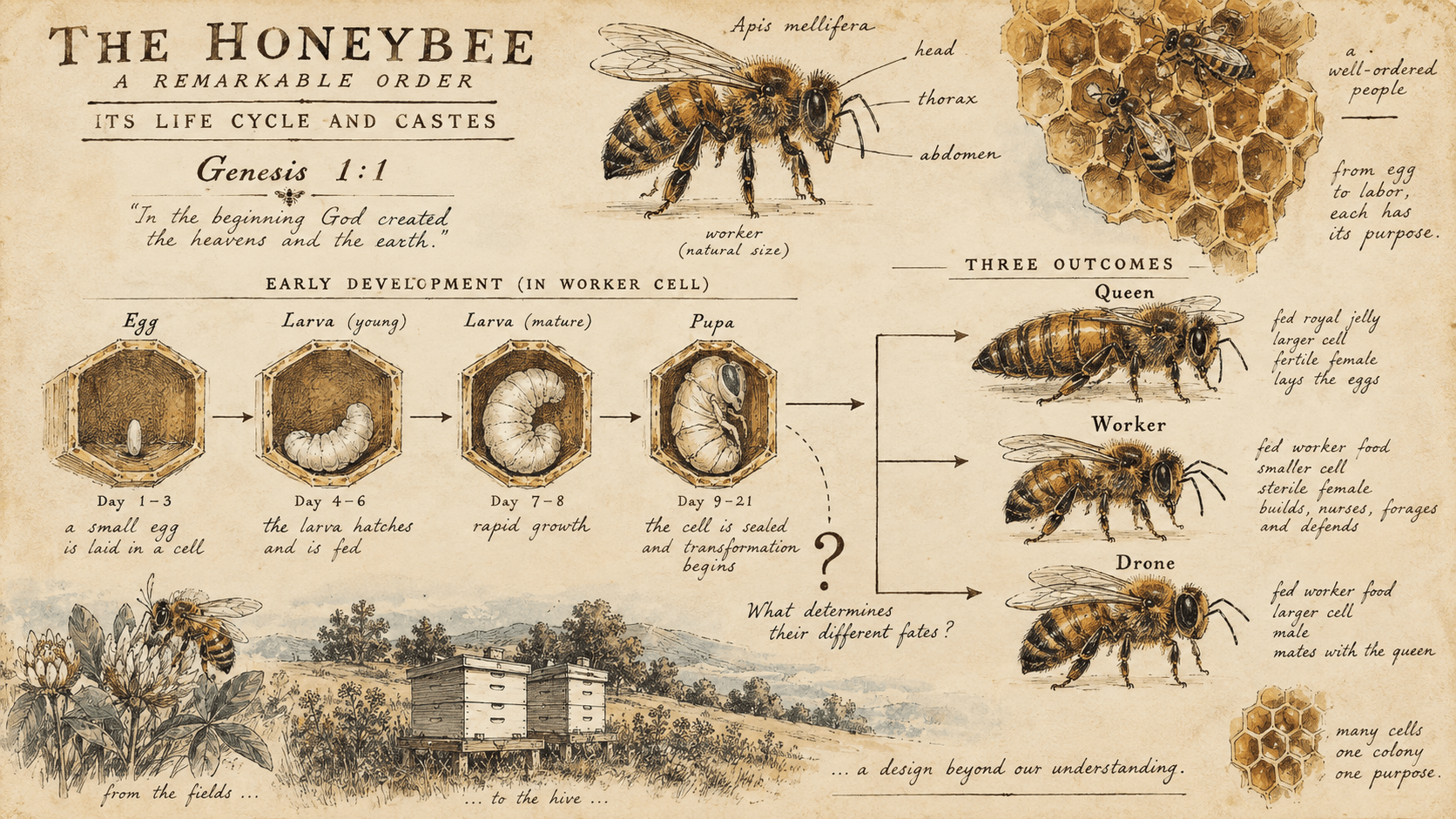
Chapter 6 lines up two systems that look chaotic from the outside but were never improvising. When half of Casey's strongest hive swarmed on a Tuesday morning, he assumed disaster, until he found queen cells already built and waiting: planned succession the workers had prepared while the old queen was still laying. The colony wasn't scrambling to replace her. It had already decided. The historical anchor works the same way. In 1841, John Tyler settled a constitutional question nobody had tested yet: does the vice president become president, or just fill in? He took the oath and governed as president, full stop, over his own cabinet's objections. That precedent sat unused for twenty-four years until Lincoln was shot in 1865, and when it mattered, Andrew Johnson was sworn in within hours with no debate at all. The plan had already been built. Nobody in that hotel parlor was inventing it on the spot. Casey's point isn't that the question in the chapter's title, what came first, doesn't matter. It's that watching a colony execute a plan it never asked his opinion on taught him the difference between keeping bees and what he calls being a "beedirector," someone who assumes every good outcome needs his hand on it. The queen cell was already built. The precedent was already set. Genesis 1:1 is where Casey lands on why: a Creator who plants tomorrow's answer inside today's preparation doesn't need anyone standing over the hive directing traffic.
Bee Science
- Queen cell emergence
- a worker's cell cap is fully chewed away when she emerges; a queen instead cuts a clean, precise circular opening near the cell tip that can swing open on a hinge or reseal behind her
- Queen-on-queen sororicide
- the first virgin queen to emerge doesn't wait to see who else is coming — she goes cell to cell hunting her still-sealed rivals, chewing a ragged hole in the side of each one and stinging the occupant
- Time from swarm departure to new queen
- about a week passes between a swarm's departure and the first new queen's emergence
- Caste-determination complexity
- the genetic differences that produce a queen versus a worker involve hundreds of coordinated gene expressions, and even the most primitive social bees known already show real division of labor
Cited research (1)
- Thomas D. Seeley, Honeybee Democracy (Princeton University Press, 2010), pp. 42-44: Source for the first-virgin-queen sororicide behavior (chewing holes in rival cells, stinging the occupants) and the roughly one-week gap between swarm departure and the new queen's emergence; the circular/hinged-cap detail on how a queen opens her own cell is general apicultural knowledge, not sourced to Seeley specifically
Scripture
Anchor: Romans 1:20
Also touches
Civil War Recordcivil war
The Tyler Precedent (1841) and Andrew Johnson's succession after Lincoln's assassination (1865)
- William Henry Harrison died April 4, 1841, one month into his term — the shortest presidential tenure in U.S. history; Vice President John Tyler resolved the Constitution's ambiguous succession language by assertion, taking the oath and governing as president in full rather than 'acting president'
- Tyler's move was politically contested at the time — Daniel Webster and the rest of Harrison's cabinet resisted it — but it held and was never re-litigated by any subsequent vice-presidential succession
- Lincoln was shot at Ford's Theatre on April 14, 1865 and died at 7:22 a.m. the next morning; Vice President Andrew Johnson was sworn in by Chief Justice Salmon P. Chase later that same morning, in a private parlor at the Kirkwood House hotel in Washington, with no debate about whether he was fully president
- By 1865, the succession question the Tyler Precedent had settled had already gone unquestioned through every prior vice-presidential succession
Primary sources (5)
- Wikipedia, "Tyler Precedent"
- Washington Post, "The Tyler Precedent: How John Tyler became president after William Henry Harrison in 1841"
- National Constitution Center, "A controversial President who established presidential succession"
- Library of Congress, "Andrew Johnson taking the oath of office in the small parlor of the Kirkwood House [Hotel]"
- U.S. Senate, "The Swearing In of Andrew Johnson"
verified
From the Book
I was having a complete hot mess moment when half my strongest colony swarmed on a Tuesday morning. One day they were humming along perfectly, the next day half the bees were gone with the old queen, leaving me staring at what looked like a decimated hive. I'll be honest, I was frantic, and a little embarrassed about it too. Swarming itself is completely natural, bees have been doing it since long before anyone kept them in a box, but a beekeeper who's staying on top of things can usually see it coming and get ahead of it: splitting the hive yourself, giving them more room before they feel crowded, a handful of other tricks that head off the urge to leave in the first place. I hadn't done any of that. My first instinct was to call Marc, who always had a queen or two on hand to sell, certain that without my intervention this colony was doomed. But something made me pause and actually look at what the bees had left behind. There, on the bottom of several frames, were queen cells the workers had prepared before the swarm departed. Not one or two, but half a dozen. These weren't emergency cells thrown together in panic, they were planned succession, prepared while the old queen was still laying eggs and ruling the hive. The bees had seen this coming and gotten ready for it, while I'd been completely clueless.
Get the full book →