© 2026 Casey Spitnale
Chapter 5
The Nurse Bee
Feeding the Flock
“How doth the little busy bee / Improve each shining hour / And gather honey all the day / From every opening flower!”
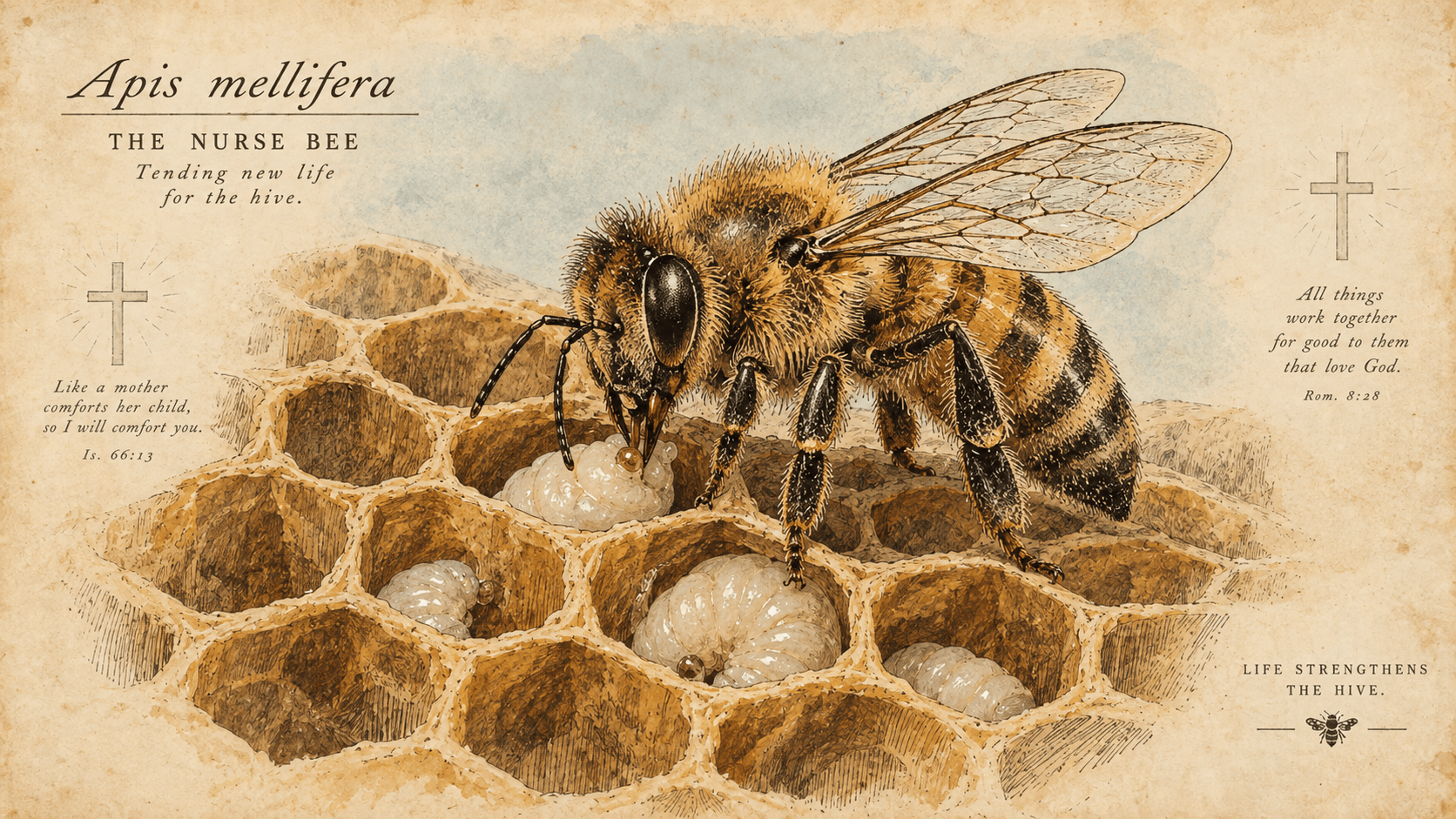
Chapter 5 pairs Bruce Lineburg's 1922 stopwatch study, more than ten thousand timed nurse-bee visits, with two Civil War caregivers who worked the same way: Walt Whitman wandering Washington's hospital wards with oranges and letters for men he'd never met, and Mary Ann Bickerdyke chasing down real food for soldiers wherever the need was worst. None of them worked from a fixed schedule. Lineburg's numbers show a nurse bee visiting a cell more than 1,300 times a day on average, climbing to 2,855 times the day before it's capped, but the visits track the larva's actual need, not the clock. The diet changes on day three, not day four as the older beekeeping books claimed, because that's when the larva actually needs it to change. Casey reads that pattern against Matthew 6:11's daily bread and the widow of Zarephath in 1 Kings 17, who fed Elijah from a jar of flour that shouldn't have lasted. Neither the nurse bee nor the widow had a guarantee going in. Both fed whoever was in front of them first and let the supply catch up. Whitman and Bickerdyke did the same thing on a bigger, bloodier stage: no rank, no fixed post, just wandering toward the next hungry man. The chapter's point isn't that planning doesn't matter. Nolan's research shows a queen has to hit her peak laying weeks before anyone can see the harvest coming, and a nurse bee's own circadian clock is quietly running before she ever needs it. It's that foresight and responsiveness aren't opposites. A colony can be built for a future it can't see and still answer whoever's hungry today.
Bee Science
- Nurse-bee visit frequency
- a cell gets looked in on more than 1,300 times a day on average, climbing to 2,855 visits on the day before it's capped, with close to five hours of a nurse's head actually down inside it that final day
- Larval diet timing
- a larva is fed brood food alone through day 2, with pollen and honey folded in starting day 3 — correcting the older, widely repeated claim that the diet changed on day 4
- Queen's peak lay timing
- 18,000+ brood photographs across sixteen colonies over two seasons showed a queen needs to hit her peak laying about six weeks before the honey flow, so the workers who'll bring in the harvest are laid, fed, and grown before it starts
- Nurse-to-forager circadian switch
- a nurse bee keeps no day/night schedule at all and sleeps in short naps at any hour; only after she becomes a forager does a sharp, sun-tuned rhythm switch on, with longer sleep stretches outside the cells, mostly after dark
Cited research (5)
- Mark Winston, The Biology of the Honey Bee (Harvard University Press, 1987): Documents the precise schedule on which nurse bees' hypopharyngeal glands develop and reach peak royal-jelly production
- James A. Nelson, Arnold P. Sturtevant & Bruce Lineburg, Growth and Feeding of Honeybee Larvae, USDA Department Bulletin No. 1222 (1924): Source of both the nurse-visit-frequency figures and the day-3 (not day-4) larval-diet-change correction; see notes/research/nelson-sturtevant-lineburg-growth-feeding-larvae-1924.md
- W.J. Nolan, USDA Bulletin 1349 (1925): Photographed sealed brood in sixteen colonies over two seasons; established the six-weeks-before-the-flow peak-laying timing and corrected inflated queen egg-laying-rate figures then common in beekeeping literature
- Guy Bloch, Dan P. Toma & Gene E. Robinson, "Behavioral Rhythmicity, Age, Division of Labor and period Expression in the Honey Bee Brain," Journal of Biological Rhythms 16(5): 444-456 (2001): Nurse bees show no circadian behavioral rhythm; the clock genes run quietly in the brain regardless, before she ever takes up foraging
- B.A. Klein, K.M. Olzsowy, A. Klein, K.M. Saunders & T.D. Seeley, "Caste-dependent sleep of worker honey bees," Journal of Experimental Biology 211 (2008): The youngest bees sleep the most, in short arrhythmic naps, often inside an empty cell; foragers sleep in longer, mostly-nocturnal stretches outside the cells
Scripture
Anchor: Romans 1:20
Also touches
Civil War Recordcivil war
Walt Whitman's Washington hospital years and Mary Ann 'Mother' Bickerdyke's wartime relief work, 1861-65
- Civil War camp rations rarely matched the official list: stale, weevil-ridden hardtack got fried in salt-pork grease into 'skillygalee,' and pressed cakes of dried vegetables (officially 'desiccated,' nicknamed 'desecrated') were boiled into soup
- Walt Whitman's brother George was wounded at Fredericksburg in December 1862; Whitman searched Washington-area hospitals for three days before finding him alive with a minor wound, then spent years afterward bringing wounded and dying soldiers he'd never met small comforts (oranges, candy, letters home), funded by Brooklyn friends' donations separate from his own paymaster's-office clerkship income
- Whitman inscribed a war notebook 'Walt Whitman, Soldier's Missionary'; he was never an official nurse
- Mary Ann 'Mother' Bickerdyke, a widowed botanic physician in her forties, arrived in Cairo, Illinois in 1861 with church-collected supplies and no rank, credentials, or pay, and had hospitals cleaned and real food coming from the kitchens within days; Sherman is remembered dismissing a surgeon's complaint about her authority by saying she outranked him
- In 1865 near Louisville, Kentucky, Bickerdyke arranged a wagonload of potatoes for scurvy-stricken troops bound for Texas, and when the steamer had already pulled out into the river, flagged it back from the landing herself: 'It shall come back!'
Primary sources (4)
- Whitman Archive, "Walt Whitman to Louisa Van Velsor Whitman, 29 December 1862" (item loc.00758)
- HistoryNet, "'I Am Well and Hearty' - Walt Whitman's Brother in the Civil War"; National Archives, "'Whitman, Walt, Clerk'"
- Mary A. Livermore, My Story of the War (1889), pp. 538-540 (Bickerdyke's potato-boat rescue)
- Library of Congress "Civil War in America" exhibition; National Museum of Civil War Medicine, "'She Ranks Me': The Story of Mother Bickerdyke" (Bickerdyke biography)
verified
From the Book
The first time I really watched nurse bees work, I couldn't make sense of what I was seeing. Marc had pulled a frame from the heart of his strongest hive and pointed to a cluster of young bees moving across the comb in what looked like complete chaos. "Watch them closely," he said, his weathered finger tracing their paths. "See how they're randomly looking for tasks to complete?" I squinted through my veil, trying to follow individual bees as they wandered from cell to cell, heads disappearing into the hexagonal chambers, emerging, moving on, then circling back. It wasn't the organized assembly line I'd expected but something more like controlled wandering, purposeful yet unpredictable, as if each bee was seeking where she was needed most rather than following a predetermined route. After their initial days of cleaning cells, these young workers transform into the colony's nurturers, developing specialized glands in their heads that produce royal jelly, a creamy white substance dense with protein. From days 3 to 10 of their brief lives, they become living milk factories, visiting each larva thousands of times over the course of its development, though watching them move, it's hard to believe there's any system to it at all. They seem to wander randomly across the brood comb, checking this cell, feeding that one, moving on to another section entirely before returning to where they started. Yet somehow, every larva gets fed exactly what it needs when it needs it, the apparent randomness producing perfect results that would make any nutritionist envious.
Get the full book →