© 2026 Casey Spitnale
Chapter 4
The House Bee
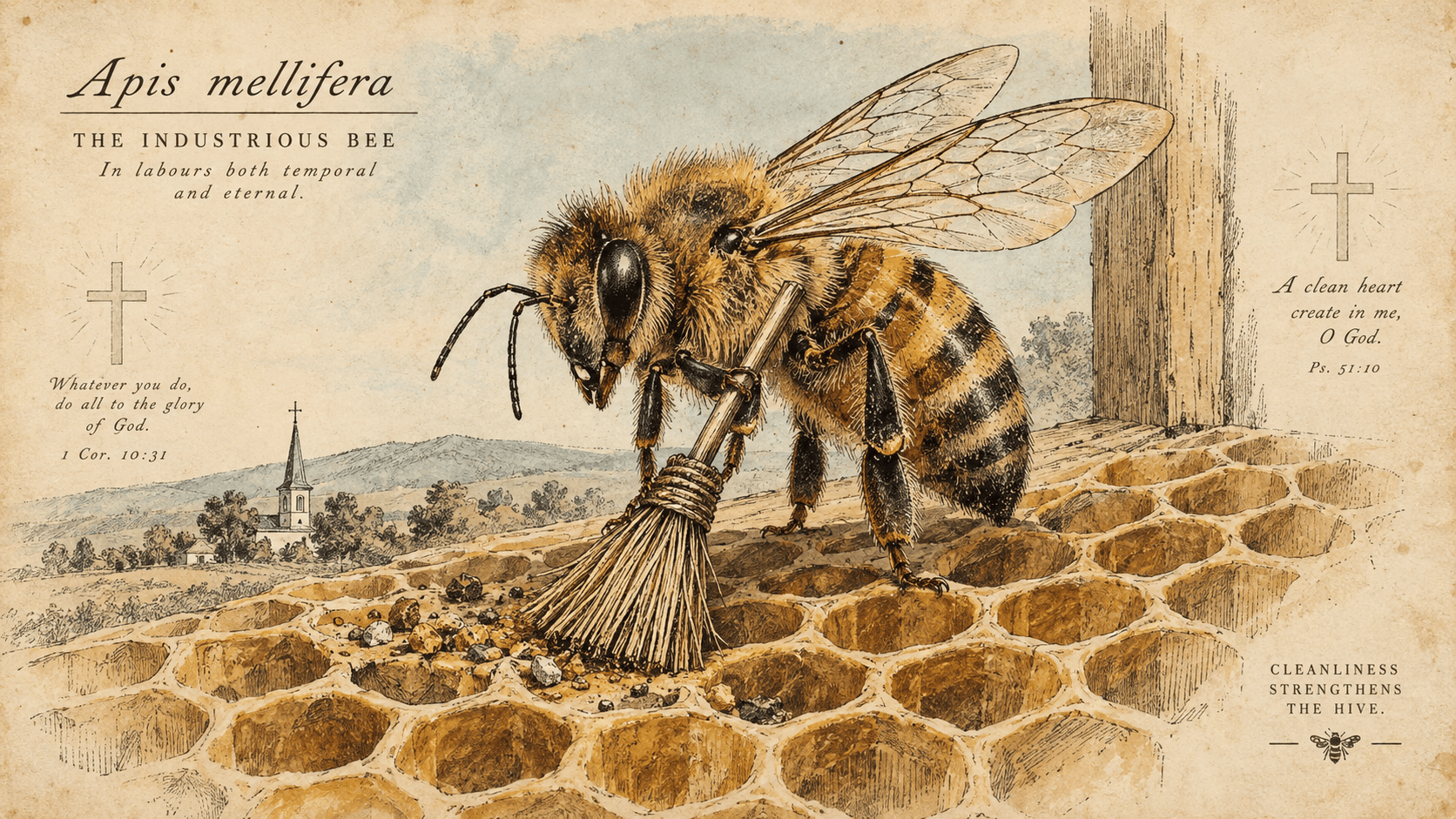
Cleaning the Temple
“No writer can get near enough to touch the hem of the garment of the industry of honey-bees.”
Casey opens this chapter with the job nobody wants: a newly hatched worker's first three days are spent hauling dead bees and old cocoon silk out of the hive, work that looks like nothing until you notice it happens constantly, not just after a hard winter. That ordinary, uncredited labor is what he lines up against Clara Barton and Dorence Atwater's work at Andersonville. Atwater copied out thirteen thousand names of the dead at real risk to himself; Barton wrote to the families and helped turn numbered stakes back into headboards with real names on them. Neither one did that work for credit. They did it so someone else, later, would know. The bee science backs up why the unseen part matters so much. Nelson and Sturtevant's 1924 measurements found a larva growing to over 1,500 times its hatching weight in under five days, all of it happening inside a cell some house bee scrubbed clean and then never saw again. She doesn't stick around for the payoff. Casey reads that straight through Mark 4:27, the seed that grows while the sower sleeps, not because the growing can be explained, but because it was never hers to watch. That's where Romans 12:1-2 lands for Casey: a living sacrifice doesn't get to check on its own results. The house bee cleans and moves to her next job. Barton and Atwater named the dead and moved on to the next name. The chapter's case is that most of what actually holds a hive, or a church, together happens exactly like that, unseen and unfinished from the inside, and still worth doing.
Bee Science
- Worker bee lifespan and role sequence
- a worker bee lives about six weeks in summer, moving through five or six roles in sequence — cleaner, nurse, builder, guard, forager — rather than one job her whole life
- Winter bees vs. summer bees
- workers raised in late summer and fall carry high levels of the blood protein vitellogenin and live for months instead of weeks, long enough to carry the queen through to spring
- Larval growth rate
- an egg weighs about 0.1 mg; four and a half to five days after hatching, the larva weighs more than 1,500 times that — faster growth than the silkworms and moth caterpillars measured alongside it
- Task assignment tracks the job, not age
- in same-age experimental colonies, where age can't be what's deciding anything, bees still sort into cleaners, nurses, and foragers; foragers carry more serotonin than nurses, regardless of birthday
Cited research (4)
- W.C. Rothenbuhler, "Behavior genetics of nest cleaning in honey bees. I. Responses of four inbred lines to disease-killed brood," Animal Behaviour 12:578-583 (1964): Established what beekeepers now call hygienic behavior: some colonies detect disease-killed brood, uncap the cells, and remove the dead pupae before infection spreads — the foundational study behind all later hygienic-behavior and Varroa-resistance research; replaces an earlier, fabricated citation of Seeley & Morse 1976, see notes/research/rothenbuhler-hygienic-behavior-1964.md
- Nelson, Sturtevant & Lineburg, USDA Bulletin 1222 (1924): Weighed honeybee larvae on a chemical balance daily from hatching to capping; source of the 1,500x larval growth figure
- Mattila, Harris & Otis, "Timing of production of winter bees in honey bee colonies," Insectes Sociaux 48 (2001); Amdam & Omholt, "The regulatory anatomy of honeybee lifespan," J. Theor. Biol. 216 (2002): Winter bees are physiologically distinct from summer bees (higher vitellogenin, months-long lifespan), not just the same bee enduring cold weather
- Thamm et al., 2013 (PLOS ONE): Reviewed serotonin-receptor findings showing brain chemistry tracks a bee's current task rather than her age in single-cohort (same-age) colonies
Scripture
Anchor: Romans 1:20
Also touches
Civil War Recordcivil war
Clara Barton and Dorence Atwater naming the Andersonville dead, 1865
- Dorence Atwater, a former Andersonville prisoner assigned as a clerk to copy the prison's official death register, secretly copied the list a second time for himself at real personal risk — more than 13,000 names
- In mid-1865, Atwater and Clara Barton joined an Army expedition back to Andersonville; soldiers replaced the numbered grave stakes with permanent headboards bearing the dead's actual names and units, matched against Atwater's list
- Barton wrote to thousands of families telling them where their son or husband had died and was buried, and was given the honor of raising the American flag for the first time over the newly dedicated Andersonville National Cemetery
- Barton went on to run a 'Missing Soldiers Office' in Washington; by the time she closed it in 1867, she and her staff had identified more than 20,000 missing men, nearly 13,000 of them the soldiers Atwater's list had already named at Andersonville
- Bryan, Ohio's own Company C of the 100th Ohio was captured at Limestone Station, Tennessee on September 8, 1863, and sent to Confederate prisons including Andersonville; fifteen of Company C's men died in those prisons, and Philip Hayes of the neighboring 103rd Ohio (who later settled in Bryan and wrote his regiment's history there) witnessed the capture from a few hundred yards away
Primary sources (2)
- NPS.gov, 'Clara Barton and Andersonville'; Clara Barton Missing Soldiers Office Museum; Emerging Civil War, 'Clara Barton's Search for Missing Soldiers' (2023)
- Private Jacob Fewloss, Co. C, National Tribune, March 4, 1897 (with casualty roster); Philip C. Hayes, Journal-History of the Hundred & Third Ohio Volunteer Infantry (Bryan, Ohio, 1872)
verified
From the Book
We've met the queen, one bee in fifty thousand who exists to lay eggs, and the drone, who exists for exactly one flight and nothing else. Everyone else in that box, all the rest of those fifty thousand, is a worker: a female who never mates and never lays a fertilized egg, but who spends her whole short life, six weeks in summer, working for the colony. What makes her different from the queen or the drone isn't just her sex. It's that she doesn't do one job her whole life. She does five or six of them, one after another, aging into each new role on a schedule as reliable as a calendar. She starts as a cleaner. Then a nurse. Then a builder. Then a guard. Then, right at the end, a forager, flying out to bring home the nectar and pollen the whole hive runs on. The next several chapters follow her through that entire arc, one stage at a time, starting here, on day one, with the job nobody wants: cleaning up the dead. The hive's winter die-off, at first glance, looks like nothing but devastation: a bottom board scattered with tiny corpses, a colony that looks wiped out by cold and hunger.
Get the full book →