© 2026 Casey Spitnale
Chapter 2
Queenless
When the Center Goes Silent
“The bees find that they have lost their queen, they make manifest their loss by their wild excitement and bewilderment. No one can witness this excitement without seeing that something is wrong.”
This chapter grew out of one discovery: a queenless hive doesn't just lose its leader, it loses its bearings, and the loss looks closer to grief than to ordinary disorder. Colin Butler's 1954 mesh experiments back that up in a way Casey finds hard to shake. A queen behind a single screen, close enough for workers to touch and feed her, keeps a colony calm. The same queen behind a double screen, close enough to smell but not touch, and the colony starts building emergency queen cells within hours, convinced she's already gone. Whatever holds a hive together has to be passed bee to bee. Nearness alone isn't enough. Casey reads Robert E. Lee's reaction to Stonewall Jackson's death the same way. Lee didn't reorganize his army because a battle plan called for it. He split Jackson's old command into two new corps because no single presence he had left could fill the gap, and the army spent the rest of the war finding out what got lost in that split, most visibly at Gettysburg, where the new arrangement hesitated at Cemetery Hill in a way Jackson's old command likely wouldn't have. The chapter's spiritual point follows both threads to the same place. Acts 2:42 describes a church that didn't just believe in Christ's presence from a distance, it broke bread together, hand to hand, the way Butler's bees pass queen substance mouth to mouth. And when that presence goes missing, whether in a hive gone queenless or a person who's drifted, the fix isn't punishment. It's what Christ offered Peter in John 21: the chance to come back whole, even after everything that led to the drift.
Bee Science
- Time to laying-worker collapse
- a queenless colony reliably develops laying workers (multiple eggs per cell, scattered on the cell walls rather than centered) within about three weeks of losing its queen
- Queen substance transmission
- a queen caged behind a single wire mesh (touchable) keeps a colony calm; the same queen behind a double mesh with a gap (smellable but not touchable) triggers emergency queen-cell building within hours — proof the pheromone must be physically passed bee to bee, not just smelled
- Laying-worker colonies are self-blind
- a colony with laying workers 'is in a hopeless situation': believing it already has a queen, it won't rear a queen from another colony's larvae or accept its queen cells — recovery requires uniting it with a strong, queenright colony
- A hopeless colony rescued anyway
- in a study of about 20 queenless colonies (1943-44), one left queenless for five weeks with no eggs or young larvae raised a viable queen anyway from a laying worker's egg — a fluke Butler put at no more than 1 in 100
Cited research (3)
- A. Pettigrew, The Handy Book of Bees, 1875: Firsthand 19th-century beekeeper's description of a freshly queenless colony 'in a state of great commotion and lamentation for their loss, running hither and thither in search of her' — quoted directly in the chapter, verified against handy-book-of-bees.md
- Colin G. Butler, The World of the Honeybee (Rothamsted Experimental Station), 1954: Discovered and named 'queen substance': single-mesh vs. double-mesh cage experiments and a rubber-diaphragm split-body experiment, proving the substance moves by contact, not scent alone
- Gentry, Small Scale Beekeeping, Peace Corps (Peace Corps Information Collection & Exchange), 1982: Documents the laying-worker colony's 'hopeless situation' and the recommended remedy of uniting with a strong queenright colony
Scripture
Anchor: Romans 1:20
Also touches
Civil War Recordcivil war
Stonewall Jackson's death and Lee's May 30, 1863 reorganization of the Army of Northern Virginia
- Stonewall Jackson was accidentally shot by his own pickets after dark at Chancellorsville on May 2, 1863, mistaken for Union cavalry in the confusion; his left arm was amputated the next morning
- Lee's immediate reaction: 'He has lost his left arm, but I have lost my right.' Jackson developed pneumonia and died May 10, 1863; Lee wrote to his son the next day, 'It is a terrible loss. I do not know how to replace him.'
- On May 30, 1863 (Special Orders No. 146), Lee split the army into three corps instead of two: Longstreet kept the First Corps, Richard Ewell took Jackson's old Second Corps, and A.P. Hill took a new Third Corps
- Lee's own stated reason, in a letter to Jefferson Davis: the old two-corps structure put ~30,000 men under each commander, 'more than one man can handle... always beyond the range and vision & frequently beyond his reach'
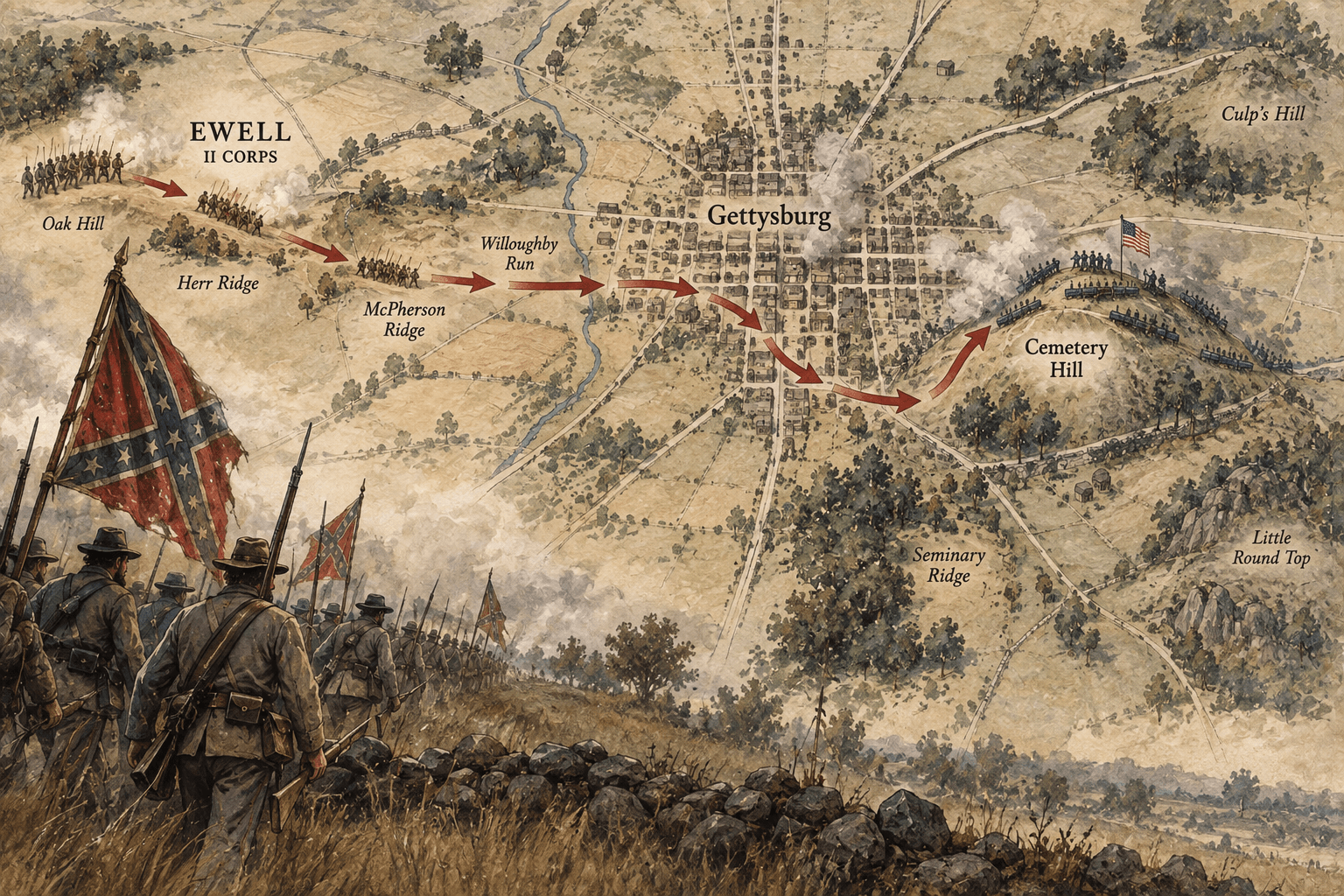
- On July 1, 1863 at Gettysburg, five weeks after Jackson's death, Ewell's corps drove Union forces back through town and reached the base of Cemetery Hill with daylight left, but chose not to press the attack; the hill stayed in Union hands, and Pickett's Charge broke against that same ground on July 3
Primary sources (3)
- History.com, 'Confederate general Thomas J. "Stonewall" Jackson dies'
- Douglas Southall Freeman, Lee's Lieutenants, vol. 3 (Lee's 'beyond the range and vision' letter to Jefferson Davis)
- Historynet, 'Richard Ewell at Gettysburg'; The Civil War Center, 'General Lee's "If Practicable" Order to General Ewell'
verified
From the Book
I didn't truly grasp the queen's importance until I met a queenless hive. One spring, I approached one colony and sensed something was wrong. The once-gentle hum was replaced by a loud, chaotic roar. The bees moved with frantic, desperate energy; the hive's rhythm was visibly off. Inside, it was worse. Thousands of bees rushed everywhere, their usual order gone. They crowded my veil, showing alarm and distress. Workers continued their tasks of cleaning, tending to the brood, and collecting nectar, but at a panicked speed, the colony barely holding together. The queen had died sometime in the last 2-4 weeks. Without her presence, the colony was unraveling. Workers had begun making new queen cells, but the damage continued to grow. Watching their desperate activity, I realized something: without Christ's presence, people can keep living, but spiritually, they are burning with that restless fire I saw in the queenless hive. Directionless, they lack true purpose. Beekeepers a century and a half before me watched the exact same unraveling and reached for the exact same word: grief. Andrew Pettigrew, writing in 1875, described a freshly queenless colony as bees "in a state of great commotion and lamentation for their loss, running hither and thither in search of her," language he wasn't reaching for as metaphor. He'd simply kept enough hives to know that's what the loss actually looks like from the outside. The bees aren't only reacting to a missing chemical signal. Something in a colony recognizes an absence and can't settle until it's answered.
Get the full book →