© 2026 Casey Spitnale
Chapter 1
The Queen
The Heart of the Hive
“No human monarch was ever half so well attended to by his subjects as a queen bee is by hers.”
Casey didn't set out looking for a queen bee. He set out looking for four-leaf clovers between innings of Little League, on the theory that patient, distracted searching sometimes turns up something extraordinary hiding in a patch of grass everyone else is standing on. Years later, at a neighbor's hives for the first time, that same patience found the queen before the neighbor, Marc, could even point her out. The rest of the chapter follows what a queen actually does with her authority. She lays up to 2,000 eggs a day, but she leads the other 50,000 bees in the hive by scent, not by force, a chemical presence her attendant court carries to every corner of the colony. Casey reads that pattern, presence over command, alongside a moment from September 1862: when Lincoln restored George McClellan to command after Second Bull Run, the army rallied around him before he'd given a single order. No punishment tour, no relitigating what had gone wrong. Order returned the moment the right leader did. The chapter's real claim is bigger than either bees or generals, though. It lands on Ephesians 5:23, Christ leading the church the way the queen leads the hive, and 1 Peter 2:9, ordinary larvae made royal not by what they earned but by what they were fed. A single bee weighing less than a paperclip coordinates fifty thousand others without saying a word. Casey's case, across the whole chapter, is that a system this precise isn't an accident.
Bee Science
- Queen egg-laying rate
- up to 2,000/day at her peak (measured research puts typical peak lower, ~1,000-1,600/day)
- Queen's attendant court
- 10-20 workers in constant rotation, feeding, grooming, and spreading her pheromones
- Mating flight
- one nuptial flight (occasionally 2-3 over a few days) around age 5-6 days, mating with 7-15 drones; sperm stored for the rest of her multi-year life
- Royal jelly transformation
- exclusive royal jelly the whole larval period (vs. 3 days for workers) yields a queen ~50% larger, with developed ovaries and a years-long lifespan vs. a worker's weeks
Cited research (4)
- Pankiw et al. (2004), Journal of Economic Entomology 97(3): 748-751: Brood pheromone increases pollen-foraging activity and target-crop fidelity
- Pankiw (2004), Naturwissenschaften 91(4): 178-181 (PMID 15085275): Worker (forager vs. pre-forager) pheromones regulate the age at which a bee begins foraging
- Slessor & Winston — Queen Mandibular Pheromone (QMP): QMP specifically suppresses worker ovary development and coordinates colony tasks; distinct from the two Pankiw studies above, which are about worker/brood pheromone, not the queen's
- Wanner et al. (2007), PNAS 104: 14383-14388: Primary source validating the ch.1 pheromone-signal chart (QMP components, QRP, footprint, Dufour's, tergal, BEP, Koschevnikov gland, AmOr11 receptor) — see notes/research/pheromone-catalog.md, "Validated chart for Chapter 1, 2026-09-16"
Scripture
Anchor: Romans 1:20
Also touches
Civil War Recordcivil war
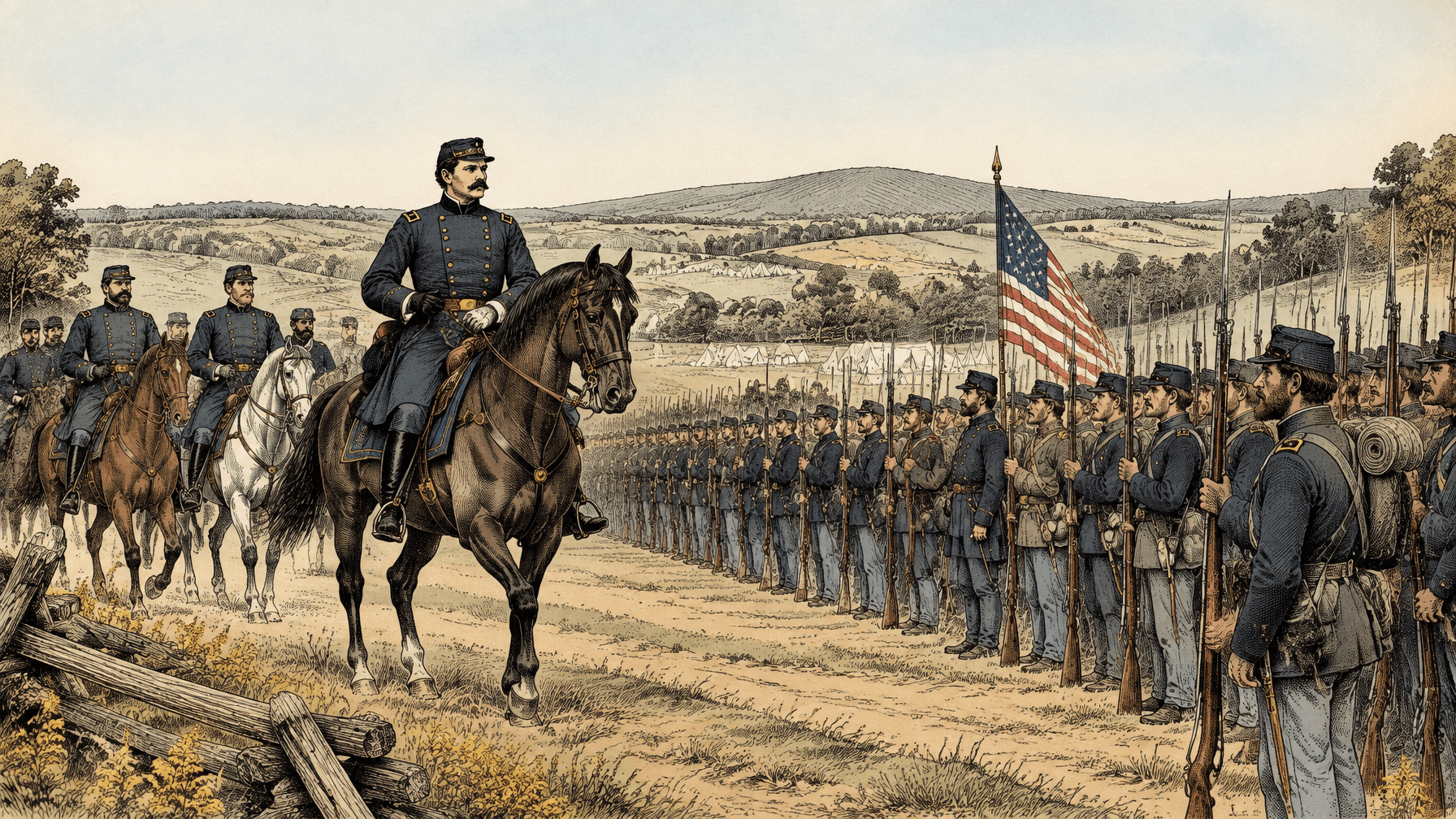
McClellan's restoration to command, September 2, 1862
- Union General John Pope's army was routed at Second Bull Run (Aug 29-30, 1862) and streamed back into Washington demoralized; Lincoln, over Cabinet objection, restored George McClellan to command on September 2
- The New York Herald reported McClellan 'most vociferously cheered' riding the line that day; on September 6, roughly 20,000 soldiers serenaded his H Street house with sixty cannon
- That loyalty wasn't manufactured after the fact: a Journal of the Abraham Lincoln Association study of soldier letters and camp correspondence found the sentiment was genuine and persistent, not partisan myth-making
- It was earned: in 1861 McClellan turned a shaken post-First-Bull-Run force into a 125,000+-man trained, equipped army by March 1862, capped by the November 20, 1861 Grand Review at Bailey's Crossroads (~70,000 troops, per the New York Times)
Primary sources (3)
- History.com, 'This Day in History: McClellan is restored to full command'
- New York Herald (contemporary report); New York Times (Grand Review account)
- Journal of the Abraham Lincoln Association, "McClellan Redux? The Often-Reported, Imminent Return of Little Mac"
verified
From the Book
"Find a four-leaf clover before the game," our little league baseball coach, Spanky, told us, "and you'll get a hit." While others were quick to give up searching, I kept at it. Game after game, I methodically searched the outfield, crouched down in the grass while my teammates were already practicing. I'll admit it wasn't exactly disciplined outfield play. Somewhere around age eight I decided a four-leaf clover was a better use of my time between at-bats than actually watching the game, which tells you everything you need to know about my attention span out there. I looked for evidence of the extraordinary, a genetic miracle among thousands, hiding in the same patch of grass everybody else was standing on and ignoring. Every patch felt like a chance God hid something special for whoever was patient enough, or distracted enough, to notice. It wasn't an instant find. I had to search for what seemed like years, but my persistence finally paid off. I found a perfect four-leaf clover. The grass seemed to part, revealing it. I tucked it into my cap like a good luck charm, marched up to the plate certain I had God and genetics both on my side, and struck out anyway. Whatever that clover was doing for me, it apparently didn't extend to actually making contact with the ball. But that first find showed me: sometimes you have to look longer to recognize divine handiwork in the world, even when the handiwork has nothing to do with your batting average. This patient, attentive approach proved useful the first time I saw a queen bee, at Marc's hives.
Get the full book →